
AI-powered vs AI-driven: there is a difference and people are blurring it
I replaced my entire marketing team with AI agents. Cool. What happened the first time the agent sent the wrong message to 3,000 prospects? What happened when it paused the wrong campaigns and burned the month budget in 72 hours? What happened when a DELETE query ran without a WHERE clause? These are not hypotheticals. They are what happens when you take humans out of the loop and let AI act without review.
"I replaced my entire marketing team with AI agents."
Cool. What happened the first time the agent sent the wrong message to 3,000 prospects? What happened when it paused the wrong campaigns and burned the month's budget in 72 hours? What happened when a DELETE query ran without a WHERE clause?
These are not hypotheticals. They are what happens when you take humans out of the loop and let AI act without review.
The distinction nobody is drawing carefully
There is a difference between AI-powered and AI-driven that a lot of people in this feed are blurring, sometimes deliberately.
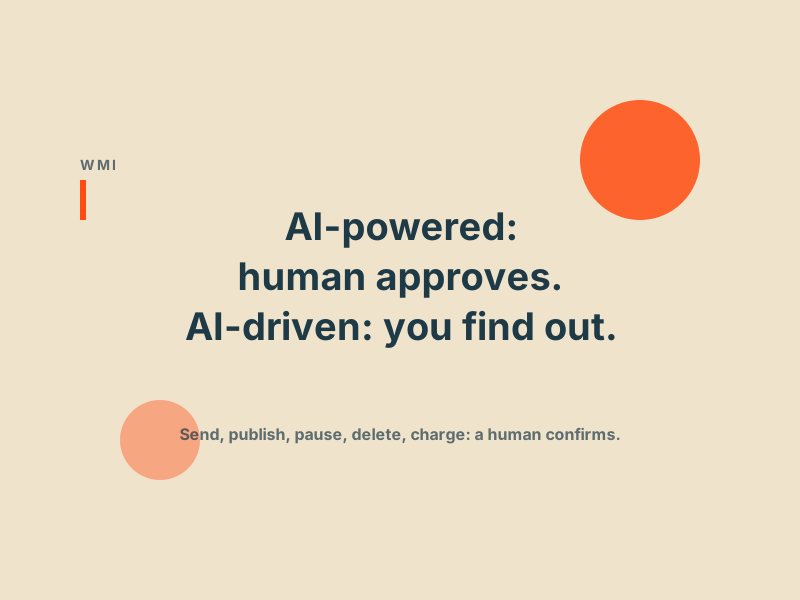
AI-powered: the AI drafts the email, the human sends it. The AI builds the audience, the human approves it. The AI flags the anomaly, the human decides what to do. You get speed and scale. You keep accountability.
AI-driven: the AI decides, acts, sends, and deletes. You find out what happened from the consequences.
The people posting "comment CLAUDE and I will send you my fully automated marketing workflow" are selling you the second version while describing the benefits of the first. The workflow is autonomous. The consequences are yours.
Where the line actually sits
Every serious AI implementation we have seen in paid media, CRM, or client communications has a human checkpoint before anything irreversible happens.
The irreversible actions:
- Send (emails, SMS, push notifications)
- Publish (social posts, ads, landing pages)
- Pause (live campaigns, automations, sequences)
- Delete (records, audiences, conversion actions)
- Charge (any spend over a threshold, any budget cap change, any new campaign launch)
A human confirms before these happen. That is not a limitation. That is the architecture.
The reversible actions can be more delegated:
- Draft (the human reads and approves)
- Analyse (the human reviews and decides)
- Recommend (the human triages and acts)
- Report (the human notices what needs attention)
- Tag, classify, categorise (errors are easy to correct)
The split is not about AI capability. It is about consequence reversibility. The same model can be trusted with both classes of task; only one class has been delegated to act unsupervised.
Why "zero human involvement" is a liability transfer
"Zero human involvement" is not a feature. It is a liability transfer dressed up as efficiency.
When the autonomous agent sends the wrong message, the platform vendor's terms of service make clear that the responsibility sits with the operator. The audit trail shows the operator configured the workflow. The financial consequence sits with the operator. The reputational consequence sits with the operator.
The "AI agent did it" framing does not survive a serious client conversation, an enforcement action, or a regulator inquiry. The same setup that produced the autonomous workflow is the one whose name is on the invoice and the privacy policy.
What to actually do
- For every AI workflow in your operation, classify each action as reversible or irreversible.
- Add a human checkpoint to every irreversible action. The checkpoint can be fast, but it must exist.
- Document who owns each checkpoint by name and what their approval criteria are.
- Audit the workflow quarterly. Drift toward autonomy is common as teams get comfortable.
- Be suspicious of anyone selling "fully autonomous" workflows that touch any of the irreversible categories.
Be suspicious of anyone who tells you otherwise.
If you want help designing an AI-powered workflow with the right checkpoints for your account, book a free audit.
Get a free PPC audit from the team that wrote this.
We'll review your Google Ads or Microsoft Ads account and show you three specific things we'd change in the first 30 days.