
Your 30-day attribution window and weekly ROAS targets are mathematically incompatible
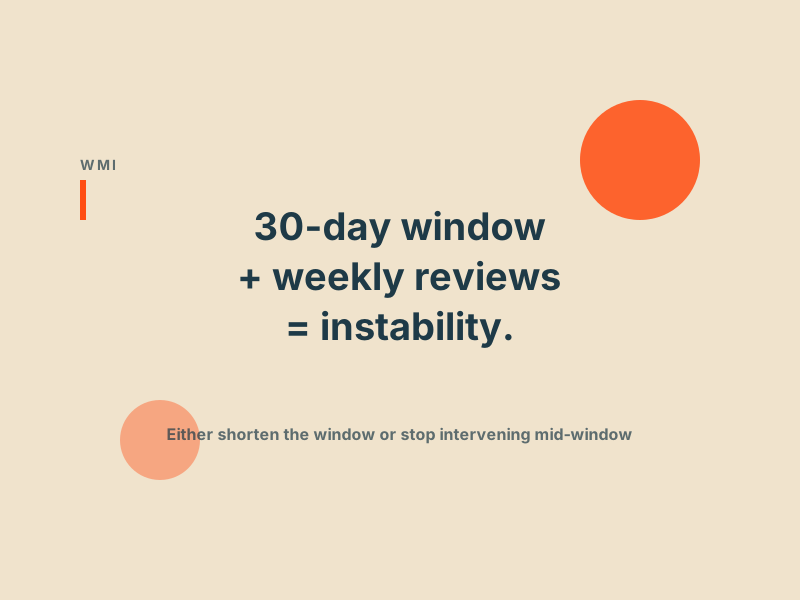
Smart Bidding sees a click, waits up to 30 days for a conversion. But the account is reviewed weekly. If ROAS looks low on Wednesday, someone adjusts the target before the attribution window closes. The algorithm trains on incomplete data, then gets new instructions before the previous one finishes resolving. The bidder never stabilises. This is a measurement architecture problem, not a bidding problem.
Your 30-day attribution window and your weekly ROAS targets are mathematically incompatible, and most accounts run both simultaneously.
Here is what happens. Smart Bidding sees a click. It waits up to 30 days for a conversion to attribute back to that click. But the account is reviewed weekly, and if ROAS looks low on Wednesday, someone adjusts the target or the budget before the attribution window closes.
The algorithm is training on incomplete data, then getting a new instruction before the previous one finishes resolving. The result is a bidding model that never stabilises. It is not a Smart Bidding problem. It is a measurement architecture problem.
Why this compounds
Smart Bidding works by building a model of which auctions are worth bidding more in, based on observed conversion outcomes from past auctions. The model needs a stable feedback loop: a bid decision goes out, conversions come back in some predictable window, the model updates.
If the feedback loop is broken, every subsequent bid decision is built on noise. Specifically:
- The algorithm sees a low conversion count because most of the conversions from the last week are still in their attribution window
- It interprets this as a performance problem and reduces aggressive bidding
- It hits the new, lower bid ceiling and serves fewer impressions
- Conversions trickle in over the next 14 days from the previous higher-bidding period
- The model now sees an inconsistent picture: bid less, get more conversions, bid more, get fewer
- The auction behaviour becomes harder to predict, CPCs become more variable, and the account looks volatile
- The instinct is to intervene more frequently, which compounds the original problem
Eventually the bidding strategy looks broken and someone proposes switching from Target ROAS to Manual CPC. The switch usually does not help. The problem was never the bidding strategy. It was the cadence of intervention on top of an attribution window that needed time to settle.
The two ways out
The fix is not complicated, but it requires discipline. Pick one:
Option A: shorten your attribution window to match the cadence at which you review and act. If the account is reviewed weekly, set a 7-day attribution window. The algorithm will then have settled feedback within the review cycle. The trade-off is that some conversions from longer consideration cycles will not be credited back to the campaign that started them, so reported ROAS may be lower. That is fine, as long as it is consistent.
Option B: stop making bid strategy changes mid-window. Set a target, leave it for the full attribution window plus one week, then evaluate. For a 30-day window, that is a 5-week minimum review cycle. The pressure to "do something" weekly is the problem, not the answer.
Most accounts do neither. They run a 30-day window because that is the default, and they review weekly because that is the team cadence, and they intervene whenever a single bad week shows up.
What to actually do
- Document your current attribution window per conversion action. Most accounts have a mix: 30-day click, 1-day view-through for some, 7-day click for others. The defaults vary by conversion type and are rarely audited.
- Compare your review cadence against your attribution window. If they do not match, you have the problem this post describes, regardless of how the campaigns are performing right now.
- Pick a direction. Either match the attribution window to the cadence (usually shorten it) or extend the review window to match the attribution period.
- If you keep the 30-day window, agree a "no-touch" rule. Bid targets and budgets do not change during the attribution period of an active campaign except in genuine emergencies (broken tracking, broken landing page, budget cap hit early).
- Track the bid-strategy stability separately from the campaign performance. If your CPCs are swinging more than 25 percent week-over-week without an external explanation, the algorithm has not stabilised and intervention is more likely the cause than the cure.
The second-order effect
An unstable bidding model inflates variance in auction behaviour. CPCs become harder to predict. CPA targets drift. The account looks volatile and the instinct is to intervene more frequently, which compounds the original problem.
If your account has been running the same bid strategy for six months and performance still feels erratic, check whether your attribution window and your optimisation cadence are even speaking the same language.
They probably are not.
If you want help working out whether your current attribution and review setup is fighting itself, book a free audit and we will diagnose the measurement architecture before recommending any campaign changes.
Get a free PPC audit from the team that wrote this.
We'll review your Google Ads or Microsoft Ads account and show you three specific things we'd change in the first 30 days.