
When you set a tROAS target campaigns cannot reach, Smart Bidding does not try harder. It bids less.
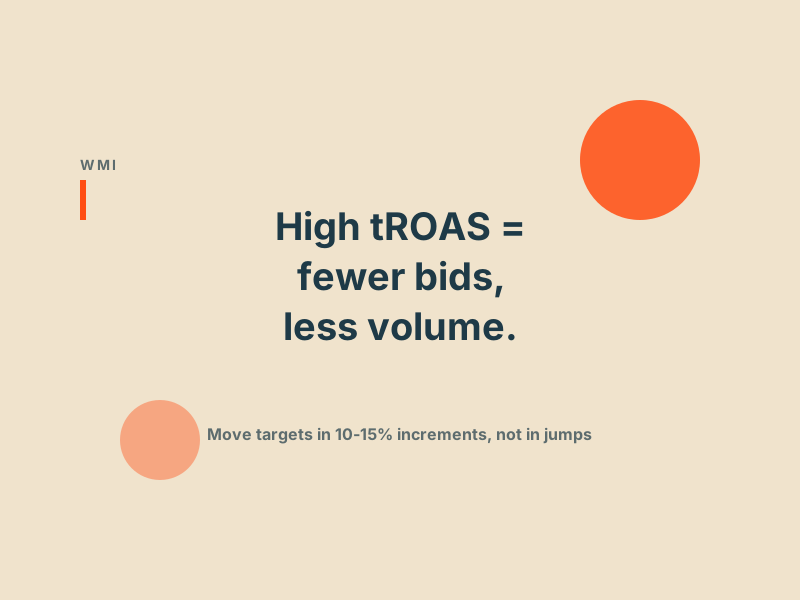
Google's tROAS algorithm targets a return on ad spend and adjusts bids to achieve it. If you set a 500% target on a campaign averaging 300%, the algorithm reads every auction as high risk and restricts spend. Impression share drops. Reported ROAS goes up (because you only win the highest-value auctions). Someone reads that as success. Meanwhile total conversions fall and you are leaving real revenue on the table.
When you set a tROAS target your campaigns cannot reach, Smart Bidding does not try harder. It bids less.
Google's tROAS algorithm targets a return on ad spend and adjusts bids to achieve it. If you set a 500 percent tROAS target on a campaign that has been averaging 300 percent, the algorithm reads every auction as high-risk and restricts spend. Impression share drops. The account looks like it is underperforming on volume because it is: the bid strategy is refusing auctions it calculates as unprofitable at your stated target.
The consequence is predictable. Spend goes down, reported ROAS goes up (because you are only winning the highest-value auctions), and someone reads that as the strategy working. Meanwhile, total conversions fall and you are leaving real revenue on the table.
Why the misread happens
The pattern looks like success on most dashboards. The line being watched is ROAS. ROAS improved. Someone calls it a win. The fact that revenue fell by 20 percent at the same time gets attributed to "market conditions" or "seasonality" or "we tightened our targeting", none of which is the actual cause.
The actual cause is that the bidder is doing what you told it to do. You told it 500 percent. It only bids on auctions it predicts will return 500 percent or better. The set of those auctions is much smaller than the set it would bid on at 300 percent. So it bids less often. Volume falls. Of the volume that remains, the bidder cherry-picks the highest-value queries, and reported ROAS rises.
The reporting layer never tells you "we are leaving revenue on the table because the target is too aggressive." It just shows you the numbers and the numbers look good.
How to set tROAS targets correctly
The correct approach is to set tROAS targets close to actual account performance and reduce (or increase) them gradually.
The pattern that works:
- If your account is running at 300 percent, set the tROAS target at 300 percent. Not at 400 or 500 because "we would like better."
- Hold it for two to three weeks. Let the algorithm stabilise on the new target. Watch volume, not just ROAS.
- If the algorithm is stable and you want to push efficiency, move the target 10 to 15 percent higher. 300 to 345, then 345 to 395, then 395 to 450 if the prior step held. Each step needs two to three weeks of data to know whether it held.
- If volume drops more than the ROAS improvement justifies, back off. The previous target was the right one.
- If you want to push volume rather than efficiency, move the target down in similar increments. Same logic in reverse.
The accounts that do this well do not set targets where they want to be. They set targets where they are, and move in small increments. The bidder needs auction data to recalibrate. Jumping straight to your desired target treats it as a thermostat. It is not.
When the volume drop is appropriate
There are cases where deliberately tightening tROAS and accepting the volume loss is the right call:
- You are out of inventory and need to slow demand
- You have a margin compression event (rising COGS, currency shift, supplier change) that makes the previous tROAS unprofitable
- A new lower-funnel campaign type just launched and the lift in non-attributed revenue justifies pulling top-of-funnel back
- The product mix has shifted toward higher-margin items and the absolute revenue at lower volume is now more profitable
- You are deliberately suppressing acquisition during a seasonal pause
In each of these cases, the volume drop is a feature, not a bug. The mistake is when teams tighten tROAS hoping for "better performance" without one of these specific reasons, then misread the resulting volume drop as success.
What to actually do
- Pull the gap between your current tROAS target and your actual trailing 30-day performance for every active Smart Bidding campaign. If the gap is more than 20 percent, the target is probably suppressing volume.
- Reset the target to match recent actual performance. Hold for three weeks. Watch volume return.
- If you want better efficiency, move the target in 10 to 15 percent increments with three-week holds between moves. Document the volume impact at each step.
- Add weekly volume monitoring to any tROAS campaign, not just ROAS. The two metrics need to be read together.
- If your tROAS target has not changed in six months and performance feels stable but flat, run a deliberate test at a 10 percent lower target for two weeks. The volume that returns is often more incremental than expected.
What is the gap between your current tROAS target and your actual trailing 30-day performance?
If you want a free review of whether your current bid targets are quietly capping your account volume, book a free audit and we will check the math before any change is made.
Get a free PPC audit from the team that wrote this.
We'll review your Google Ads or Microsoft Ads account and show you three specific things we'd change in the first 30 days.