
AI proposes. A second AI argues. A human decides.
Your account is run by AI Employees that read the data, draft the changes and write the reporting. Every proposal is reviewed by a different model, then waits for a person to approve it. Nothing reaches your ad account on its own.
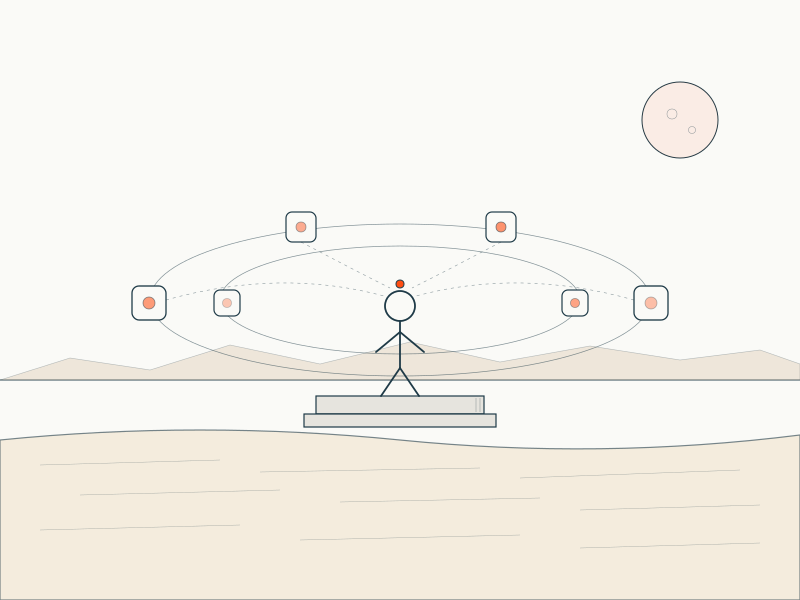
The hard part was never the automation.
Getting a model to suggest a budget change is trivial. Getting it to suggest one you would be comfortable applying to a live account, on a Tuesday, without reading every line first, is the entire problem.
So the work went into the parts nobody demos: what a move is allowed to be, how often it can happen, who else edited the account this week, what gets re-read afterwards to confirm it landed, and which model is allowed to say yes. The answer to that last one is none of them.
What is live right now.
Not a catalogue of what the platform could do. This is what runs on paying accounts today.
Proposes changes to live campaigns on Google and Meta. Every move is scoped, capped and approved one at a time before it touches the account.
- Pause and unpause
- Budget changes, capped at 25% per move
- Audience exclusions
- Placement exclusions
- Campaign and ad set builds
A second model reads every proposal before it reaches you. It asks two questions: is any move wrong, and what did this run fail to look at. It holds no approval authority of its own, by design.
- Independent review model
- Objections recorded on the proposal
- Verdict returned to the proposing agent
- Cannot approve anything, ever
The Monday morning briefing, written from the account rather than from a template. Every draft is graded before it goes out, and ungraded drafts do not ship.
- Weekly performance report
- Monthly report with workbook per account
- Four comparison windows
- Profit and POAS for commerce accounts
The layer that makes the rest worth having. Qualified outcomes go back to the ad platforms, so bidding optimises against pipeline instead of form fills.
- GA4, GTM, GCLID, UET
- Offline conversion tracking
- Call tracking
- Consent and GDPR baseline
Nothing happens behind your back.
The reason most businesses will not let AI near a live ad account is that they cannot see what it did. Three properties fix that, and they are in the substrate rather than bolted on afterwards.
Every action writes to an audit log before it runs. What happened, when, which AI Employee did it, and what it was reading from. Executed moves are re-read against the account afterwards to confirm they landed as reported.
There is a kill switch and a stand-down. Work in flight stops. If the change history cannot be read, the system fails closed and does nothing rather than proceeding blind.
Moves are narrowing by default and undoable. An agent may only unpause what it paused itself. Nothing is a one-way door unless you agreed it should be.
Every action carries a tier. The tier decides whether it runs on its own, runs and tells you, waits a while, or waits for you. Anything touching an ad account or a customer sits at L4 or above.
Routine work with no external effect. Reading an account, logging an event.
Executes and logs it. You can audit afterwards, you do not need to pre-approve.
Sits for a window, then goes. You can review or hold at any point in the window.
Nothing happens until a human approves. Every campaign change lives here.
Flagged for a human. The AI will not touch it regardless of how confident it is.
The layer that answers the leads.
Most wasted ad spend is not a bidding problem. It is an enquiry that arrived at 9pm and got answered at 10am, or a warm lead from four months ago that nobody followed up.
We build and deploy this layer per client rather than running it as a shelf product, because it has to load your material and sound like you before it is worth anything. It starts in shadow mode: it drafts, you read every draft, nothing sends until you are happy.
- Web Chat
- SMS
- Messenger and Instagram DM
- Voicemail triage
- Lead Qualifier
- Lead Scorer
- Appointment Setter
- Email Lifecycle
- Lead Reactivation
- Cart Abandonment
Scoped with you before anything is built. If your enquiry volume does not justify it, we will tell you that instead of selling it to you.
It does not run your account unattended, and we are not going to say it does.
The agents work in supervised sessions, on demand, with a ceiling on how much they can change in a day. A senior human still holds the account. We are building toward a bar of fifty approved moves with zero reversals before any agent's remit widens, and we are counting honestly rather than counting what we would like to be true.
If that sounds slower than the pitch you have heard elsewhere, it is. It is also the reason we are willing to put it near a live account at all.
Most asked about AI Employees.
+What is an AI Employee?
A single piece of work, done by AI, with a defined contract: what it reads, what it produces, what it may do on its own, and what it has to bring to a human first. One proposes campaign changes. One reviews those proposals. One writes your weekly report. Each is scoped, logged and replaceable.
+Does an AI Employee change my campaigns without asking?
No. Campaign changes are proposed, never applied straight to the account. Each move is approved individually by a human before it runs. There is a ceiling of three moves per account per day, a thrash rule that blocks repeated edits to the same thing, and a check against the platform's own change history so that edits made by anyone else are seen and respected.
+So what actually runs unattended?
Reading and drafting. Pulling account data, spotting what moved, writing the report, preparing a proposal. Anything that writes to an ad account or reaches a customer waits for a person. That split is deliberate: the resting posture is watch and flag, not act.
+Why is a second AI reviewing the first one?
Because a model reviewing its own work is not a review. The reviewer runs on a different model from the agents it reads, asks what the proposal got wrong and what it failed to examine, and writes its verdict back to the agent that proposed. It cannot approve anything. Approval is a human act and the system refuses to let the reviewer perform it.
+What happens when it gets something wrong?
Every action writes to an audit log before it happens, so you can read back what ran and why. Work in flight can be stopped. Executed moves are re-read against the account afterwards to confirm they landed as described. Where a change is reversible, it can be reversed. Where it is not, it sits behind explicit sign-off in the first place.
+Do you still have humans doing this?
Yes, and that is not a transitional arrangement. Senior strategists hold the accounts and the client relationship. The agents complement and correct that work in supervised sessions rather than replacing it. Anyone telling you their AI runs a paid media account unattended is either wrong or not counting the cleanup.
+Can I get the chat and follow-up layer as well?
It is built and we deploy it per client rather than running it as a shelf product. Web chat, SMS, WhatsApp, Instagram and Messenger, plus lead qualification, appointment setting and email follow-up. It loads your own material, starts in shadow mode where it drafts and you read every draft, and only starts sending when you are happy with how it reads. Ask for it as part of the engagement and we scope it properly.
+What does it run on?
SingularWeb, the platform we built and operate ourselves. It is not a reseller wrapper around someone else's chatbot or an off-the-shelf rules tool. That matters because the logic, the logs and the governance model are ours to fix when your account needs something different.
See it against your own account.
The free audit is run the same way the accounts are: the agents read your account, the reviewer marks the findings, and a human signs off before it reaches you.