
Google Ads consultant vs agency vs in-house, which one fits which business
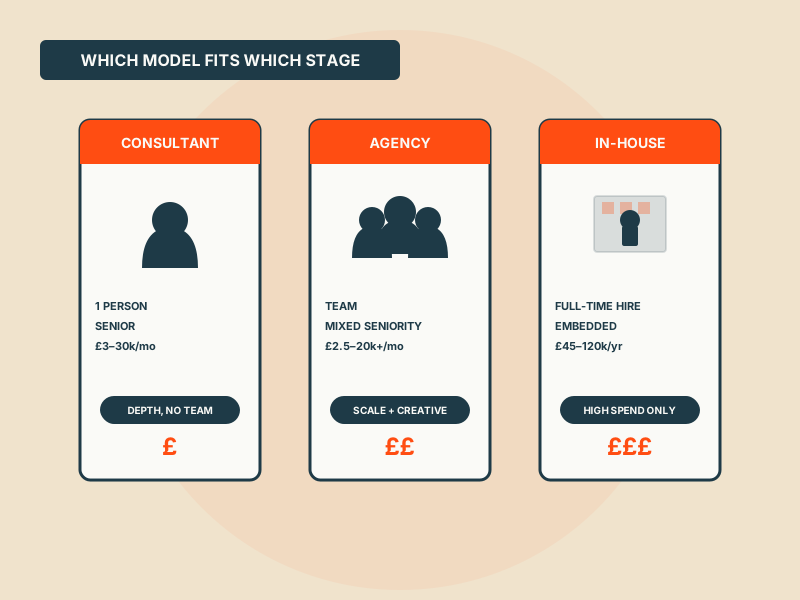
Three different engagement models that do similar-looking work at radically different price points and accountabilities. A framework for which matches your stage.
There are three ways to get Google Ads work done: hire a consultant, hire an agency, or hire someone in-house. On the surface they look comparable. In practice the economics, the accountability structures, and the failure modes are different enough that picking the wrong one for your stage is a meaningful mistake.
Here's the honest version of what each one is good for, where each one fails, and how to tell which fits your current situation.
Google Ads consultant
A consultant is usually an individual who runs Google Ads for a handful of clients concurrently, typically 5–15 accounts. They may operate under a personal brand or a small limited company. Billing is usually a monthly retainer, sometimes hourly for project work.
What a consultant is good for:
- Accounts that need senior thinking but not a full-time person. A consultant gives you one day a month of someone with 10+ years of experience, which is often more valuable than five days of junior capacity
- Businesses already running at £5k–£30k/month spend where structural decisions matter, but where the scope isn't big enough to need a team
- Situations where continuity with a specific person is important, you keep working with the same human year after year
- When in-house capacity is full and you need external depth, not external labour
Where consultants fail:
- Scale. A consultant has capacity limits. If your account needs daily attention, weekly creative turnarounds, or tight coordination with multiple stakeholders, a consultant gets overwhelmed
- Breadth. A good consultant knows one channel (or two) deeply. If you need Google Ads + Meta + TikTok + LinkedIn managed together, you either need multiple consultants or an agency
- Bus factor. The whole engagement depends on one human. If they're ill, on holiday, or leave, the account stops
Price range (UK, 2026): £1,000–£4,000/month for ongoing retainer. Higher for fractional CMO-style engagements that include strategy across the business.
Google Ads agency
An agency is a team, account managers, specialists, strategists, sometimes creative and dev resource. Depending on size, clients get varying levels of senior attention. Billing is usually a monthly retainer or a percentage of media spend.
What an agency is good for:
- High-spend accounts (£15k+/month on media) where the team structure pays back. The agency can support you through complexity, feed management, international expansion, multi-product, seasonality, without any one individual being a bottleneck
- Multi-channel accounts. A single agency running Google, Meta, programmatic, etc. gives you integrated strategy and one point of contact
- Scalable creative production. If you need volume of ad creative (copy, images, video), agencies typically have the production capacity consultants don't
- Resilience. If your account manager leaves, the knowledge and the contract stay with the agency
Where agencies fail:
- Junior-heavy execution. At typical agency economics, the day-to-day on your account is run by someone 2–3 years into their career, with senior oversight at the monthly-review level. If you expected the pitch team's brains on your account every week, you're going to be disappointed
- Generic playbooks. Agencies scale by running the same processes across many clients. That's efficient, but it also means your account gets a version of the template rather than a bespoke approach
- Slow communication. More people in the loop means more meetings, slower decisions, and sometimes a filter between what's happening on the account and what makes it into the report
- Misaligned incentives on percentage-of-spend billing. If the agency is paid 10% of whatever you spend, they're economically incentivised to recommend spending more, whether or not that's the right call
Price range: £2,500/month at the lower end of decent agencies for small accounts, up to £10k+/month for mid-size, and well into five figures a month for enterprise. Or 10–20% of media spend for spend-based models, usually with a floor.
In-house
An in-house Google Ads manager (or team) is a full-time employee or set of employees. Fully embedded in the business, answering to the marketing leader.
What in-house is good for:
- Businesses spending £50k+/month on Google Ads where the economics support hiring a dedicated person. The salary becomes cheaper than an equivalent-quality agency relationship once spend is high enough
- Deep integration with the business. In-house people sit in product meetings, talk to the sales team directly, know the customers by name. That context is hard to replicate externally
- Speed of iteration. In-house can change a campaign, talk to the landing-page team, and redeploy within a day. External partners can't match that cycle time
- Proprietary or sensitive strategy. If your ad approach involves things you'd rather not share with a third-party (pricing experiments, margin data, roadmap-linked launches), in-house removes the contractual/confidentiality problem
Where in-house fails:
- Hiring quality. A truly great Google Ads person is hard to hire in-house at typical salary bands. The best ones often prefer agency or consultant roles because of the variety and compensation upside. You may end up with someone capable but unremarkable
- Knowledge narrowing. An in-house manager running only your account only sees your patterns. They don't benefit from the exposure to 15 other accounts that a consultant or agency would have. Over two to three years, this shows up as slower adoption of new techniques
- Capacity shape. A hired in-house person is a full-time cost regardless of whether your account needs full-time attention. If your account is really a three-day-a-week job, the rest becomes padding (reports, meetings, projects that don't move the numbers)
- Single point of failure. Like a consultant but worse, the person is embedded in the business, owns the account, and if they leave they take a lot of institutional knowledge with them
Price range: £45k–£75k/year salary for a capable mid-level Google Ads manager in the UK, £75k–£120k for a senior or head-of. Plus on-costs (~25%). Plus tools, training, management overhead.
The simple framework
Map by spend and complexity:
| Spend | Complexity | Best fit | | --- | --- | --- | | Under £3k/month | Simple | Generalist freelancer or marketing lead moonlighting. Consultant is overkill. | | £3k–£8k/month | Simple | Consultant on a light retainer. | | £3k–£15k/month | Complex (multi-product, international, feed-driven) | Consultant or small agency. | | £10k–£30k/month | Simple–medium | Consultant or small agency. | | £15k+/month | Complex | Agency OR senior in-house + consultant oversight. | | £50k+/month | Any | In-house lead + agency support OR agency OR specialist team. |
Rules of thumb, not rigid categories. Your business might be an exception, but if you're deviating significantly, have a reason, not just an intuition.
The thing people skip: reviewing the choice
The mistake we see most often isn't picking the wrong model at the start, it's not revisiting the choice as the business grows or contracts.
An in-house hire made at £50k/month spend doesn't automatically become right at £10k/month spend after a down quarter. An agency that was the right fit at launch may not be the right fit once the team is scaled and the spend has tripled. Consultants perfect for the £5k/month phase become bottlenecks at £25k/month.
Annual review of the model, am I still in the right engagement type, is as important as the initial choice. Budget and complexity change faster than you notice.
Where we fit
We're a Google Ads consultancy, small team, senior-heavy, retainer model. Good fit for accounts in the £3k–£30k/month range that want senior attention without agency bureaucracy. Not a fit for businesses that need multi-channel integration, heavy creative production, or account sizes where a full agency team structure pays back.
If you'd like us to help you think through which of the three models is right for your current stage, book a free audit + scoping call. Even if we're not the right fit for the retainer, the conversation is usually useful, you'll have a sharper view of what to hire for next.
Get a free PPC audit from the team that wrote this.
We'll review your Google Ads or Microsoft Ads account and show you three specific things we'd change in the first 30 days.