
Performance marketing expert, the 5 attribution traps every claimed expert should be able to see through
The deepest skill in performance marketing isn't running ads, it's measuring what's actually working. Five attribution traps that separate genuine experts from impressive-sounding ones.
The tools to run paid ads have been commoditised. The skill that separates genuine performance marketing experts from impressive-sounding ones is attribution, knowing what's actually moving the business, vs what looks like it's moving the business in a platform dashboard.
If you're hiring or evaluating a "performance marketing expert" in 2026, the depth of their attribution thinking is the test. Ad-platform mechanics get learned in 2 years. Attribution takes 5+ years of varied accounts to get right. Here are five attribution traps that someone claiming the title should be able to see through and explain.
Trap 1: Last-click attribution making top-of-funnel look unprofitable
The trap: your Meta or YouTube top-of-funnel campaigns look unprofitable on last-click attribution because the conversion event is being credited to the final ad click (typically branded Search or direct traffic).
What a non-expert does: cuts the top-of-funnel budget because it "isn't profitable", then watches total conversions drop 2-3 months later when the awareness pipeline dries up.
What an expert sees: the last-click view is mathematically incomplete. They know to layer in:
- Data-driven attribution (DDA) in Google Ads at minimum, which redistributes credit
- Meta's attribution settings including the 7-day-click + 1-day-view window
- Cross-platform attribution via a tool like Triple Whale, Northbeam, or a self-built version
- Holdout testing to measure incrementality directly
A real expert's answer to "should we cut top-of-funnel spend?" is never just "ROAS says it's bad". It's a layered analysis that distinguishes attribution-driven appearance from real incrementality.
Trap 2: Brand search ROAS being mistaken for incremental value
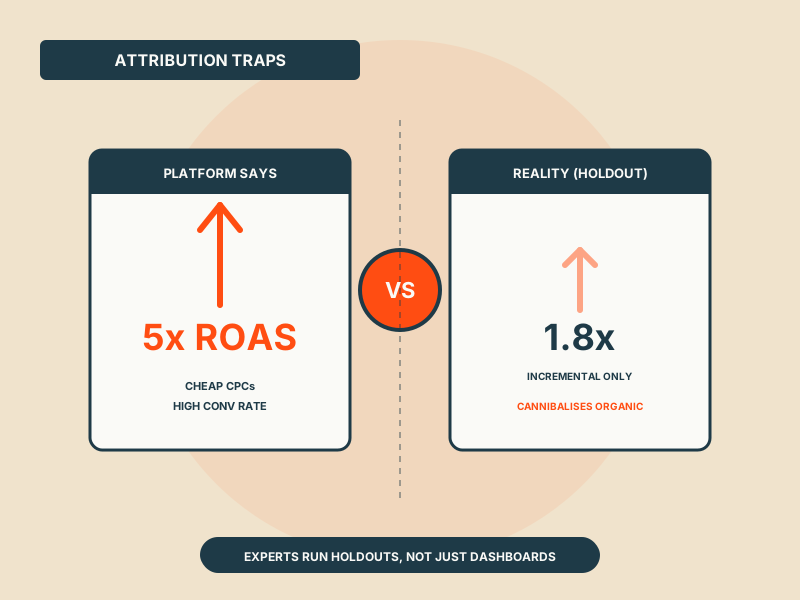
Brand search, bidding on your own company name, usually shows excellent ROAS in platform reporting. Cost-per-click is low (you're often the only relevant bidder), conversion rate is high (high-intent users), and your branded organic listing usually appears too. The dashboard looks great.
The trap: most of those branded conversions would have happened anyway. Users searching your brand name are coming because of other marketing, they'd click your organic listing if you weren't bidding. Brand-search "ROAS" is mostly cannibalisation of free traffic.
The honest test: a holdout. Pause brand bidding in 30-50% of geos for 2-4 weeks. Measure organic + direct traffic and conversions in the holdout vs the control. Real incrementality is usually 30-60% of what platform ROAS suggests. Sometimes it's 0%.
A claimed expert who hasn't run this test or doesn't know what it is, is operating on platform-reported numbers without testing them. That's not expertise.
This isn't to say brand search is always wasteful, defending against competitors bidding on your brand has real value. But the value should be measured by incrementality, not by platform ROAS.
Trap 3: Conversion-window changes being read as performance changes
Apple's iOS 14.5 update broke a lot of attribution; subsequent browser changes (Chrome's third-party cookie deprecation, Safari's ITP) have continued to erode it. Conversion windows have shortened, view-through tracking has degraded, and platform-reported conversion totals have drifted.
The trap: your CAC appears to rise after a tracking change. A non-expert reads this as performance degradation and starts adjusting bid strategy or cutting budget.
The expert sees what's actually happening: tracking degraded, the platform now sees fewer conversions, the ratio of cost to attributed conversions changed even though real CAC is unchanged. They know to:
- Reconcile platform-reported conversions against CRM/sales-data ground truth
- Adjust bid strategies to account for the new tracking baseline
- Run periodic Enhanced Conversions / offline conversion import refreshes
- Treat platform CAC as one signal, not the truth
A claimed expert who can't explain what tracking changes have happened in the last 12 months and how they've adjusted for them is running 2022 playbooks on 2026 measurement infrastructure.
Trap 4: Multi-touch attribution models being treated as objective truth
When DDA, position-based, time-decay, or any other multi-touch model assigns 30% credit to channel A and 50% to channel B, that allocation is a model output, not a measurement. The model is making assumptions about how influence flows through the customer journey based on patterns in your data.
The trap: treating model outputs as ground truth. *"DDA says Meta deserves 35% of credit, so we should spend 35% on Meta."* That's circular logic, the model's credit assignment is downstream of the data you fed it.
The expert sees attribution models as useful but provisional:
- Multi-touch is better than last-click but still based on observed-correlation, not causation
- Incrementality testing is the only way to measure causation
- Mixed-media modelling (MMM) can complement multi-touch by triangulating top-down with bottom-up
- Model assumptions matter, a position-based model with 40/40/20 allocation makes implicit claims about how journeys work that may not match reality
Real experts use multi-touch attribution as one input among several, run incrementality tests to validate the most expensive decisions, and don't pretend the model output is the answer.
Trap 5: Attribution-driven decisions ignoring the strategic level
Performance marketing experts who've over-rotated into attribution sometimes lose the strategic plot. They optimise channel mix at the margin based on attribution data, and miss bigger questions: should we be running this market at all? Is our LTV holding up? Is the category becoming structurally less competitive?
The trap: attribution-driven optimisation can keep an account "performing well" while the underlying business position deteriorates.
The expert keeps two views simultaneously:
- Bottom-up, channel-level attribution and bid optimisation, where the margins are won
- Top-down, business-level CAC trend, LTV evolution, category dynamics, where the strategic decisions are made
A claimed expert who only operates bottom-up isn't actually expert; they're a senior tactician. Genuine performance marketing expertise spans both layers and knows when each is the right view for the question at hand.
What a genuine expert does in their first 30 days
If you've hired (or are about to hire) a performance marketing expert, the first 30 days should look like this:
Week 1: Audit. Map current attribution setup, conversion tracking, platform-by-platform dashboards. Identify the biggest gaps between platform-reported numbers and business numbers.
Week 2: Fix the easy stuff. Enhanced Conversions, offline conversion import, Conversion Value Rules, server-side tagging if missing. These are unglamorous but high-leverage.
Week 3: Scope incrementality tests. Pick 1-2 expensive channels (usually brand search and one top-of-funnel) and design holdout tests. These take weeks to run; design them early.
Week 4: Strategic recommendation. Based on what's actually working (vs what platform reports suggest is working), recommend channel mix changes, attribution-model refinements, and which of the incrementality tests to prioritise.
A real expert doesn't restructure campaigns in week 1. They map the measurement first, fix the obvious tracking issues, and then make strategic recommendations. Anyone who jumps straight into bid changes and campaign restructures has skipped the work that matters most.
Where we sit
WMI's expertise is concentrated in paid search. Within that, conversion tracking and attribution is the technical core of what we do, Enhanced Conversions, offline conversion import, Customer Match, Value Rules, server-side tagging. We've run incrementality tests on brand search and top-of-funnel campaigns for clients across multiple categories.
We're not a multi-channel performance marketing expert in the broadest sense, we don't run Meta, TikTok, or LinkedIn ourselves. But within the paid-search component of a performance marketing programme, we operate at the attribution depth above. For accounts where the paid-search component needs an expert lift, book a free audit.
Get a free PPC audit from the team that wrote this.
We'll review your Google Ads or Microsoft Ads account and show you three specific things we'd change in the first 30 days.