
What a Google Ads management service actually does (and doesn't)
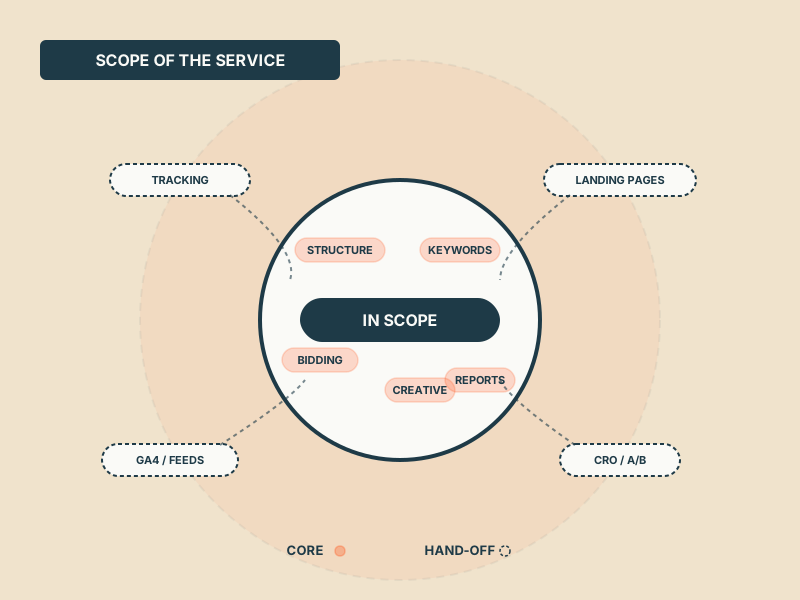
"Management" is a container word, different providers put wildly different work into it. A plain-English breakdown of what's inside the service, what's outside, and where the hand-offs should sit.
When someone says they offer "Google Ads management" they could mean any of five different service models, each with a different scope and a different cost structure. Buyers don't often ask which one they're getting, and providers don't always volunteer. The result is a recurring pattern: two months in, the client discovers the service doesn't include something they assumed it did, or the provider discovers the client expected work that was never scoped.
Here's the plain-English breakdown of what a Google Ads management service actually covers, and the bits that sit just outside it but usually need to happen for the account to work.
What's in scope: the core service
A Google Ads management service, done properly, covers everything happening inside the Google Ads platform that shapes what the account spends money on and what it produces.
Campaign strategy and structure. What campaigns exist, how they're segmented (by product, geography, match type, funnel stage), how budget is allocated between them. This is the service's single most consequential activity, structural decisions compound over months.
Keyword and negative-keyword management. What the account bids on, what it doesn't, and the ongoing maintenance of both. Search-terms review is the highest-recurring-leverage work in this category.
Bid strategy selection and management. Choosing between Maximise Conversions, Target CPA, Target ROAS, tCPM, etc., matched to the campaign's volume, goal, and learning state. Re-evaluating the choice as data changes.
Ad creative, text and asset management. Writing responsive search ads, testing variants, rotating asset combinations, removing underperformers. For Performance Max and Discovery, managing the asset groups (headlines, descriptions, images, video).
Audience signals and targeting configuration. Customer-match list uploads, in-market and affinity audiences, remarketing lists, location targeting settings, demographic modifiers.
Budget pacing and reallocation. Making sure campaigns don't under- or over-spend, reallocating budget to winning campaigns, flagging when the account is capacity-constrained.
Reporting and analysis. Monthly narrative-led reporting that answers: what did we do, what happened, what does it mean, what are we doing next.
If a service excludes any of these, it's not a full management service, it's a partial one, and the gap needs to be filled somewhere.
What's usually outside scope, but critical
These activities determine whether the managed account actually works, but they often sit just outside what the Google Ads manager is expected to do. A good service will tell you this up-front, flag when they're needed, and either include them, scope them separately, or coordinate with whoever handles them.
[Conversion tracking implementation](/blog/improve-google-ads-performance). Installing the Google Ads tag, setting up conversion actions, Enhanced Conversions for Leads, offline sales import. Most Google Ads managers can specify what's needed but don't install it themselves, that's development work. If tracking is broken, the account is flying blind.
Landing page design and build. The service will flag when a landing page is underperforming. Actually rebuilding the page is a different discipline. Expect your manager to diagnose, not to design. If they offer both, ask who actually does which.
Merchant feed and Google Merchant Center setup (e-commerce). Product feed quality directly affects Shopping and Performance Max performance. Feed optimisation is a specialism in itself and may be handled by a separate specialist, worth confirming scope.
GA4 configuration and linking. Event setup, conversion definitions in GA4, linking GA4 to Google Ads, cross-domain tracking. Some Google Ads services include this; some assume it's done by someone else.
Looker Studio or BigQuery reporting. If you want reporting beyond what Google Ads natively shows, blended CAC across channels, offline sales tracking, LTV breakdowns, that's usually an add-on, not included.
Customer data integration. Pushing sales data from the CRM back to Google Ads so Enhanced Conversions and value-based bidding can work. Requires either a server-side integration or a manual upload rhythm. Ask explicitly whether this is set up and maintained.
CRO on the landing page. A/B testing form layouts, headline variants, offer structure. A Google Ads manager can suggest tests; the execution is a separate function.
The hand-off question that matters
When scoping a Google Ads management service, the single most useful question to ask is about the hand-offs:
"When the service hits a boundary, tracking change needed, landing page update required, feed issue, what's the process for getting that resolved?"
Three types of answer, each with different implications:
1. "We do that in-house", the service is broader than pure Google Ads management. Usually more expensive. Check the depth of the in-house capability before assuming it covers what you need. 2. "We brief your team / your developer / your web agency", the service is focused, requires you to have or retain other capabilities. Usually cheaper but you're the coordinator. 3. "We flag it in the report and leave it with you", the service is purely analytical. Usually the cheapest but the burden of acting on the diagnosis is entirely yours.
None of the three is inherently wrong. The wrong choice is signing up to one thinking you're getting another.
Reporting: what "good" looks like
A Google Ads management service report should, at minimum, tell you:
- What the target was and whether the month hit it
- What material changes were made to the account in the reporting period
- What happened as a result, attribution to the changes where possible, honest acknowledgement where results are mixed or unclear
- What's planned for the next period and why
- Any external factors (seasonality, competition, platform changes) that affected results
If the report is mostly tables of numbers without commentary, that's data delivery, not management. The commentary is the work.
What we include in ours
The WMI Google Ads management service is structured as the full core scope, with explicit up-front agreement on which outside-scope items we handle, which we coordinate, and which stay with your team. Conversion tracking setup is always included at onboarding because we won't run an account we can't trust the numbers from. Landing page rebuilds are never included, we'll diagnose and brief your team or a third-party.
If you want a plain-English conversation about what your account actually needs managed vs what you're currently paying for, book a free audit. The audit doubles as a service scope conversation, by the end of it you'll know what the gap is between your current setup and what a proper service would cover.
Get a free PPC audit from the team that wrote this.
We'll review your Google Ads or Microsoft Ads account and show you three specific things we'd change in the first 30 days.