
Google Ads vs Microsoft Ads in 2026: which to start with
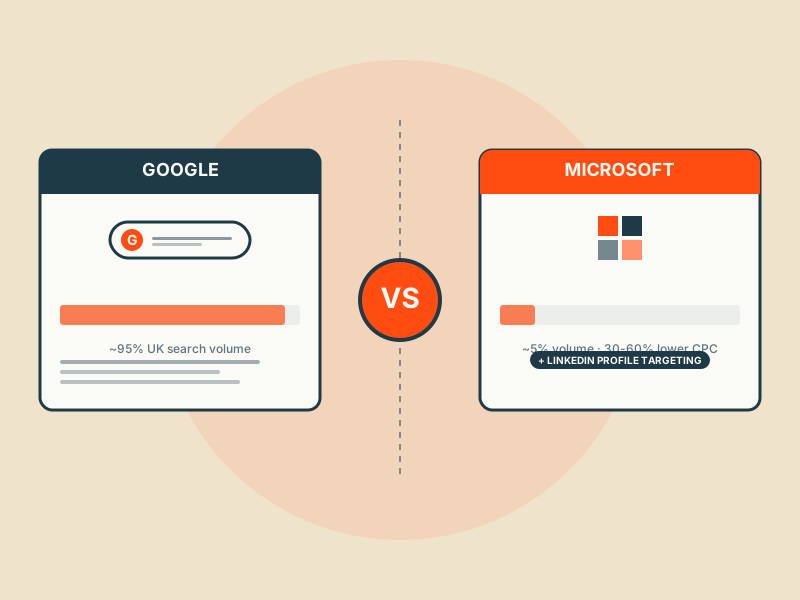
Short answer: Google first, Microsoft 90 days later, except for B2B accounts where LinkedIn Profile Targeting changes the maths. Here's the long answer with numbers.
If you're a founder, head of growth, or marketing director who has decided you need paid search but hasn't decided where, here's the short version: start with Google Ads in nearly every case, then add Microsoft Ads about ninety days in once the Google account is producing reliable conversion data and you have headroom for a second platform. The only exceptions are highly B2B businesses where Microsoft's LinkedIn Profile Targeting is a moat, some financial-services niches, and accounts where you're already at impression-share ceiling on Google and want incremental volume.
That's the answer most agencies will skip past so they can sell you a "multi-platform from day one" pitch. We don't think that's right. Here's the longer answer.
Why the question matters in 2026
In 2024 the answer was "Google, obviously." Microsoft Ads still felt like the smaller, simpler cousin, useful but optional. In 2026 the question is more interesting because three things have shifted:
- Microsoft has shipped real differentiation. LinkedIn Profile Targeting (job title, company name, industry, company size) is now stable across Search and Audience campaigns, not just Audience. For B2B accounts that's a genuine moat.
- Google's auctions have got more crowded and more expensive. Average CPCs in commercial UK verticals are up 25-40% over 2023 levels in our portfolio. The marginal click on Google in 2026 isn't always cheaper than the average click on Microsoft.
- Privacy changes have flattened audience signals. Both platforms now lean harder on first-party data and Enhanced/UET conversions. If you're going to do that work anyway, doing it on two platforms is a smaller incremental cost than it used to be.
So the calculus has changed enough that "Google by default" deserves a second look.
Audience reach: the maths is clear
Google handles about 92-95% of UK search volume in 2026 depending on how you count. Microsoft (Bing + Yahoo + DuckDuckGo + AOL) handles roughly 5-8%, plus a long tail of partner search distribution that Google doesn't touch, Edge browser default, MSN, Outlook web inbox search.
Five percent sounds small until you account for two things. First, Microsoft's audience over-indexes on certain demographics: older, higher-income, more business decision-makers, more enterprise IT environments where Edge is the default. Second, that 5% is far less competitive, fewer advertisers bidding means cleaner auctions, faster impression share for new accounts, and CPCs that come in 30-60% below Google in equivalent verticals.
In pound terms: a £10k/month Google budget might produce 40,000 clicks at £0.25 average CPC. The same £10k on Microsoft in the same vertical might produce 65,000 clicks at £0.15. Whether those clicks convert at the same rate is the open question, but you're starting with more of them.
Cost-per-click: the gap is real and persistent
Across our portfolio in early 2026, average CPC differences look like this:
- B2B SaaS keywords, Microsoft 35-55% lower than Google.
- Financial services, Microsoft 40-60% lower.
- B2C e-commerce (broad), Microsoft 20-35% lower.
- Local services, Microsoft 15-25% lower (and lower volume).
- High-funnel branded queries, roughly equivalent (the brand-protection dynamic is the same on both).
The gap is widest where Microsoft's audience demographics over-index, anything where the buyer is older or more enterprise. The gap narrows on consumer impulse buys.
The catch is that lower CPCs do not always translate to lower CPAs. Conversion rates differ by audience. For some B2B niches Microsoft converts at 2x the rate of Google because the audience is closer to the buyer; for some consumer e-commerce categories it converts worse because the audience is more browsey. The only honest answer is to test both and let the numbers speak.
Audience targeting: where Microsoft has a unique product
Google is broadly more powerful on creative formats, Performance Max, Demand Gen, YouTube placements. Microsoft is better on a handful of specific audience controls that exist nowhere else.
LinkedIn Profile Targeting. Microsoft owns LinkedIn, which means Microsoft Ads can layer LinkedIn-derived audience signals, job title, company, company size, industry, onto Search and Audience campaigns. You can't do this on Google. For B2B advertisers selling £10k+ annual contracts, this is genuinely category-defining. A Search campaign for "project management software" that filters to "marketing director at companies of 50-500 people in the UK technology sector" is a different conversation than the Google equivalent.
LinkedIn-style remarketing. The same data feeds Microsoft's Audience Network, which lets you remarket on MSN, Outlook, Edge, and Microsoft-owned properties using the LinkedIn audience filters. The targeting depth is closer to LinkedIn Ads than to Google's audience options.
Older, higher-income demographics by default. Microsoft's audience skews 35-55, household income 75th percentile and up. You don't need to set any of this up, it's baked into the audience that uses Bing, Edge, MSN.
For B2C campaigns where the buyer is younger, Microsoft's demographic skew works against you. For B2B and finance where the buyer is older and more decision-empowered, it works for you.
The decision matrix
Here's how we actually decide for new clients.
Start Google-only when:
- You're new to paid search and want to learn one platform first.
- Your buyer is broadly under-35 or impulse-driven.
- You're below £3k/month, the management overhead of two platforms exceeds the marginal volume.
- Your conversion tracking isn't yet bulletproof. Add a second platform once the first one is reporting accurately.
Start with both Google and Microsoft from day one when:
- You're a B2B business with a defined ICP that maps to LinkedIn job titles. The LinkedIn Profile Targeting alone justifies the second platform.
- You're in financial services, insurance, or enterprise IT, Microsoft's audience over-indexes here.
- Budget is £10k/month or higher and Google alone can't absorb it efficiently.
- You're switching from a multi-platform incumbent and need to maintain channel coverage during the change.
Add Microsoft to a Google-only setup at the 90-day mark when:
- Google is producing reliable conversion data with at least 30 conversions/month at a reasonable CPA.
- The Google account has hit impression-share ceilings on the queries that matter (you're winning 70%+ available impression share already).
- You have someone, agency or internal, who can give Microsoft genuine attention. A Microsoft account that's a one-time Google import without ongoing differentiation underperforms.
Common mistakes we see
Treating Microsoft as a Google clone. The one-click Google import gets you live in 30 minutes, but the campaigns you import are tuned for Google's auction dynamics, not Microsoft's. Different bidding strategies work best on each platform; different keyword match types behave differently; the LinkedIn audience overlay only exists on Microsoft. Auto-importing and never tuning is the most common reason Microsoft accounts underperform.
Splitting budget proportionally to volume. "Microsoft is 5% of search volume so I'll give it 5% of budget." This ignores that Microsoft's CPCs are 30-60% lower; on equal click volume your Microsoft spend should be roughly 50-70% of your Google spend, not 5%. We typically run 70/30 or 60/40 Google/Microsoft on accounts where both are working.
Conflating brand protection. Both platforms need brand-term campaigns, but they should be separate budget lines, not a single proportional split. Brand on Microsoft costs almost nothing; brand on Google costs more. Don't let one mask the other.
Ignoring Microsoft Shopping. UK e-commerce advertisers especially undervalue Microsoft Shopping. Same product feed, same logic, far less competition. Setup is a 30-minute job once you're in Microsoft Merchant Center.
Using Microsoft as a graveyard for Google's failed campaigns. Anything that fails on Google because it's not commercially viable will also fail on Microsoft. The platform isn't a magic incremental volume tap; it just shifts the auction dynamics. Bad keywords stay bad.
What good looks like across both platforms
The end state we aim for is: Google handling the bulk of intent capture (Search + Performance Max), Microsoft handling the demographic premium audience (LinkedIn-targeted Search + Audience Network for B2B; pure Search + Shopping for B2C), with both feeding back into a unified GA4 view via Enhanced Conversions on Google and the Conversion API on Microsoft.
Each platform has its own conversion tracking, its own bidding strategies tuned to its auction, and its own creative variations where the audience differs (older Microsoft audience → less colloquial copy, more credibility cues; same offers but different framing).
Reporting flows up to a single Looker Studio dashboard that shows blended cost-per-acquisition across both platforms so you can shift budget on a weekly basis.
TL;DR
Google first, almost always. Microsoft second, ninety days later, except for B2B accounts where LinkedIn Profile Targeting changes the maths and you should run both from day one. The CPC gap is real and persistent. The audience gap matters most for B2B and finance. The biggest mistake isn't the platform you pick first, it's treating the second one as an afterthought once you bring it in.
If you're trying to decide which platform to start with for your account, request a free audit and we'll model the volume, cost, and conversion-rate scenarios for each platform on your specific keywords. No sales call required.
Get a free PPC audit from the team that wrote this.
We'll review your Google Ads or Microsoft Ads account and show you three specific things we'd change in the first 30 days.