
Performance Max vs Search: when to use which
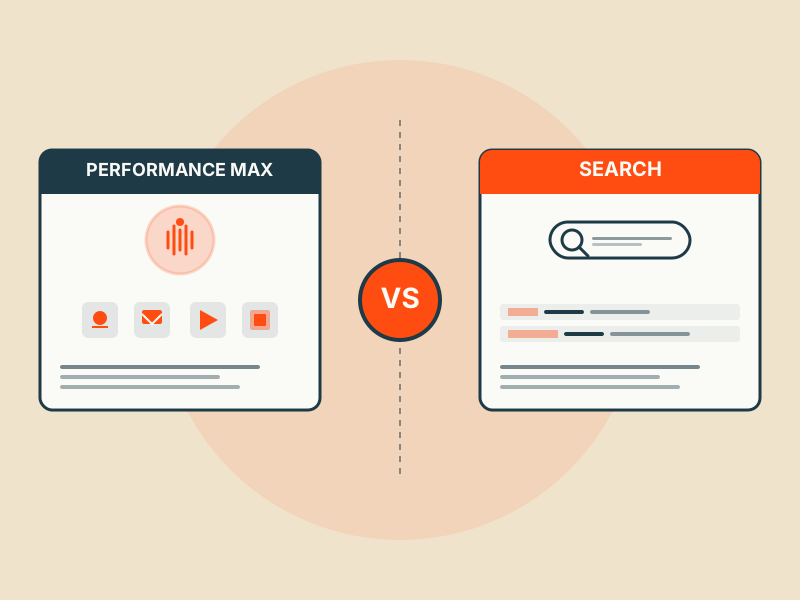
A decision framework for where Performance Max actually earns its place alongside Search, and the single biggest mistake advertisers make running both.
Every Google Ads client we speak to in 2026 has the same question: should they be running more Performance Max and less Search, or the other way round? The short answer is that they're not substitutes, they're different tools that often look alike in Google's reporting. Running them badly against each other is the single most common way to quietly burn 20–30% of a paid-search budget.
This is what we've learned managing both across hundreds of accounts over the last three years.
What each one actually does
Search is intent-matching. A user types "buy black running shoes size 10" and you bid on keywords that match that phrase. You control the query, the landing page, and the creative. When Search works, it works because the intent is already there, you're just putting your offer in front of it.
Performance Max is audience-matching with dynamic creative. You give Google assets (text, images, video, a product feed), audience signals (who your customers look like), and a goal (conversions or ROAS). Google then decides which user, which surface (Search, Shopping, Display, YouTube, Discover, Gmail, Maps), which creative combination, and which bid. You give up granular control. You get scale and automation.
These are not comparable by default. One is a scalpel; the other is a net.
When Search is the right choice
Search wins when the signal you're bidding against is the query itself. That means:
- High-intent commercial keywords where the searcher is close to buying ("best [product] for [use case]", "[brand] alternative", "[product] near me")
- Competitor brand terms where you want defensive coverage or to steal consideration
- Categories where small changes in landing page or ad copy move conversion rate meaningfully
- Lead-gen accounts where the query is the qualification signal (e.g. "commercial solar installer Manchester" is self-qualifying; a display impression isn't)
- Any account where you don't yet have enough conversion volume (under 30/month) for smart-bidding algorithms to learn
Rule of thumb: if you can write the query a converting customer would type, and that query has volume, Search is going to beat Performance Max on that slice nine times out of ten.
When Performance Max earns its place
Performance Max is at its best when:
- You have a product feed and a lot of SKUs Google can merchandise against query variety
- Your first-party data is strong, especially audience lists of past buyers and a customer-match list big enough for Google to find lookalikes
- You're trying to reach top-of-funnel users who aren't actively searching yet, and your conversion signals are good enough to let Google optimise to real business outcomes (not just clicks)
- You've already got Search covering the obvious converting queries and want incremental scale without cannibalising it
For e-commerce especially, Performance Max plus Shopping has become the default volume channel. It will find queries and placements you'd never think to bid on.
The mistake almost everyone makes
The single biggest unforced error we see: running Performance Max and Search campaigns side-by-side with no exclusions, and then believing the Performance Max reporting.
Here's what happens. Performance Max runs on Search by default. It bids on whatever queries it thinks are profitable, including queries your existing Search campaigns would have won. When Performance Max wins those auctions instead, the conversions attribute to Performance Max. Search volume drops. Performance Max reporting looks amazing. Total account performance is flat or worse, because Performance Max is paying more for the same conversions Search was already getting cheaper.
The fix:
- Add brand terms as account-level negative keyword lists applied to Performance Max, you can now do this directly from the UI
- Exclude your best-performing Search campaigns' terms from Performance Max using campaign-level negatives where supported
- Watch Search impression share, not just Performance Max ROAS. If Search impression share drops and Performance Max ROAS rises at the same time, Performance Max is eating Search, not adding incremental value
- Run Search with aggressive budgets on converting queries first. Let Performance Max pick up the long tail
A decision framework
Short version:
- Lead gen, under 30 conversions/month, or a small account where every click matters → Search first, possibly Search only
- E-commerce with a product feed and 20+ conversions/month → Search on brand and key commercial terms, Performance Max for Shopping and incremental reach
- Large accounts with mature data → both, layered carefully, with Performance Max excluded from anything Search already wins
What we do in practice
On most accounts we manage, the ratio ends up at roughly 60–70% of spend in Search and 30–40% in Performance Max, not because Google's reporting says Performance Max is the winner, but because that's where the incremental return actually lives once you look at aggregate account performance instead of the per-campaign column.
Performance Max isn't the future of paid search. Search isn't yesterday's channel. They do different jobs. Figure out which job you're actually hiring for, and you stop wasting money on the wrong one.
Get a free PPC audit from the team that wrote this.
We'll review your Google Ads or Microsoft Ads account and show you three specific things we'd change in the first 30 days.