
Why your blended ROAS number is lying to you
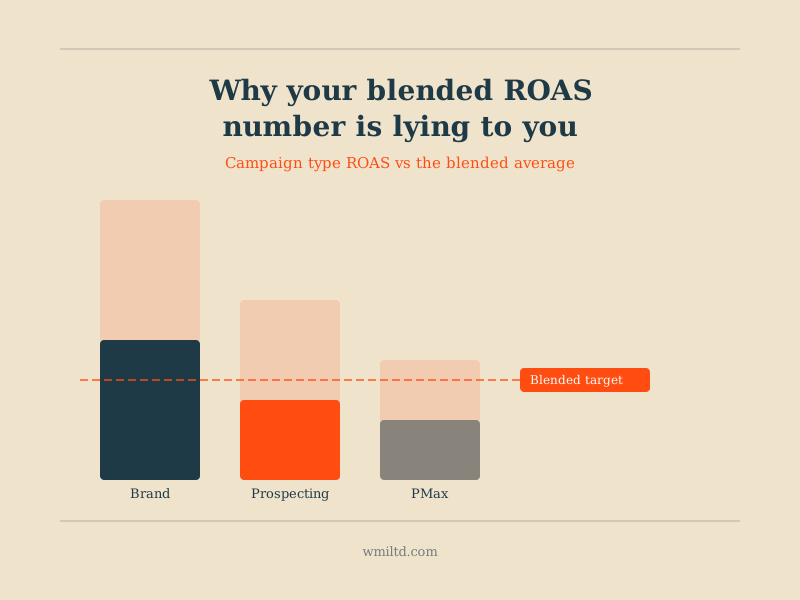
Your blended ROAS hits target, turns green, and stakeholders relax. But when you average brand search, prospecting, and Performance Max into one number, you lose the signal that tells you which part of your account is actually working. Here is how to separate the number that matters from the one that looks good.
Your blended ROAS number is easy to read. It is also one of the most misleading metrics in most Google Ads accounts. Not because the maths is wrong. Because it takes campaigns that are doing completely different jobs and averages their results into a single number that makes the account look healthier than it is.
This matters because blended ROAS is usually what gets reported to stakeholders. When the number is green, everyone relaxes. When the number is red, everyone panics. Neither reaction is necessarily correct because neither is based on what is actually happening inside the account structure.
What the blend is actually hiding
A typical mid-size Google Ads account has at least three distinct campaign types running alongside each other.
Brand search campaigns bid on queries that include the company name or close variants. These users already know the brand exists. They may have visited the site before. They are at the bottom of the purchase funnel and converting them is relatively cheap. The ROAS on a well-run brand campaign is usually excellent because you are not creating demand, you are capturing intent that was already there.
Prospecting campaigns, whether broad-match Search or Performance Max, do the opposite. They reach users who have never heard of the brand. Conversion rates are lower, CPCs can be higher, and ROAS on this type of campaign is structurally worse because demand generation costs more than demand capture. A ROAS of 3x on prospecting might be excellent given the margin profile. A ROAS of 3x on brand is a signal that something is broken.
Remarketing campaigns target users who have already been to the site or interacted with the brand in some way. Like brand campaigns, they convert well because the barrier is lower. The ROAS looks flattering by default.
When you blend these three into one number, the brand and remarketing campaigns carry the average upward. The prospecting work looks artificially better than it is. And when the blended number hits target, there is no signal that the prospecting activity is underperforming because its weakness is masked by the efficiency of campaigns that were always going to convert cheaply.
The Performance Max attribution problem
Performance Max adds a further layer of distortion. PMax runs across all of Google's inventory: Search, Shopping, Display, YouTube, Discover, Gmail. It bids on whatever it believes will convert, and it uses all available signals to find those conversions.
The problem is what PMax considers fair game. By default, it will bid on brand queries. It will bid on remarketing audiences who were already going to come back. When it wins those auctions, the conversions attribute to PMax rather than to the Search or Shopping campaigns that might otherwise have captured them. PMax ROAS looks strong. Search volume drops. Total account performance is flat or worse because you are paying PMax's CPCs for the same conversions your cheaper Search campaigns would have won.
This is not theoretical. It is one of the most consistent patterns we see when auditing accounts that switched to PMax-forward structures. The high ROAS number was real. The attribution logic behind it was not. See the most common ways Google Ads accounts leak money for the longer version of how this kind of invisible waste accumulates.
Why the blended target survived this long
Most accounts inherited their ROAS target from a brief, a conversation with a platform representative, or a spreadsheet built when the account had fewer campaigns and less automation. Nobody went back to ask whether blending still made sense once brand campaigns, prospecting, and PMax were all running together.
Platform interfaces reinforce this. Google shows account-level ROAS in the default summary view. It turns green when you hit target. There is no default view that surfaces ROAS by campaign type group and annotates which part of the structure is carrying which part of the number. You have to build that view yourself or it does not exist.
Most account managers did not build it. Most clients did not ask for it. The blended number became the goal, and hitting the blended number became the definition of a good month, regardless of whether the growth was coming from a channel that was doing something useful for the business.
The accounts that have actual ROAS control
The accounts with genuine ROAS discipline do one thing differently: they set different targets for different campaign types and evaluate each against its own purpose.
Brand search has a high ROAS target because conversion rates are high and CPCs are low. Underperforming brand campaigns are usually a keyword exclusion problem or a bidding-too-high problem. The target for brand might be 8x or 10x for a well-established name in a competitive space.
Prospecting has a lower ROAS target set by the margin available to acquire a new customer. If a customer is worth roughly £800 in gross margin and you want to acquire them at a cost that keeps media ROI positive, your prospecting ROAS target is set by that maths, not by what looks good on a graph. It might be 3x or 4x.
Remarketing sits between the two. The target should reflect that you are capturing users already in the funnel but not yet at the bottom of it.
When these three have separate targets, the blended number becomes a derivative: an output of the three component numbers rather than a goal in itself. You can look at any given week and know whether the brand campaigns are running efficiently, whether the prospecting work is paying for itself, and whether PMax is earning its budget or stealing attribution. See Performance Max vs Search: when to use which for how to structure the relationship between those campaign types properly.
What to actually do
If you are running a blended target today, here is the practical path to something more useful:
- Separate your campaign view by type. Pull a custom report segmented by campaign name convention: brand, prospecting, remarketing, PMax. Look at ROAS for each group separately. You do not need to change anything yet. Just see what you are actually working with.
- Add negative keyword lists that exclude brand from PMax. This is now possible directly from the Google Ads interface. Until you do this, PMax is counting conversions that were never really at risk of being lost, and you cannot see the true incremental cost of its prospecting activity.
- Set separate ROAS targets for brand and non-brand. The targets do not have to be final or perfect. The discipline of separating them forces the account structure to be evaluated on the right terms rather than averaged into a comfortable middle.
- Look at your prospecting ROAS when you exclude brand from the calculation. In most accounts this number is materially lower than the blended figure. That is the true cost of acquiring new customers. If the business can sustain it, keep going. If not, the strategy needs to change. This connects directly to the work in Conversion Value Rules: the most overlooked setting in Google Ads, which is about getting the right value signal into the account in the first place.
- Report to stakeholders by type, not in aggregate. It takes one extra column in a spreadsheet. Once stakeholders understand that brand ROAS and prospecting ROAS are measuring different things, the conversations about performance change. You stop defending a blended number and start having a useful discussion about where growth is coming from.
- Review Performance Max attribution quarterly. Look at the overlap between PMax search themes and your existing Search campaigns. Anywhere PMax and Search are both serving on similar queries, investigate whether PMax is adding incremental reach or cannibalising cheaper conversions.
The budget implication
The reason this matters beyond reporting is that budget follows ROAS. Accounts managed on a blended target tend to over-invest in brand and remarketing because those campaigns pull the blended number up and justify more spend. Prospecting, which is where growth actually comes from, gets squeezed because its ROAS is structurally lower and it appears to underperform against the shared target.
The result is an account that looks efficient and is not growing: the efficient spend is capturing demand that already exists while the spend that creates new demand is under-resourced. Over twelve months, this pattern produces an account with strong ROAS, flat revenue, and no obvious explanation inside the platform for why growth has stalled.
Most of the accounts we audit with flat growth and healthy blended ROAS have exactly this structure. A proper structural review, looking at campaign type ROAS independently against the margin targets that actually govern the business, reveals the gap within the first session. The fix is not complicated once you can see it. The barrier is building the reporting layer that lets you see it at all.
If you want to know whether your blended ROAS is masking an underinvestment in growth, book a free audit. We will separate the number by campaign type, set the right targets for each, and show you where the account structure is hiding what is actually happening.
Get a free PPC audit from the team that wrote this.
We'll review your Google Ads or Microsoft Ads account and show you three specific things we'd change in the first 30 days.