
What's in a Google Ads audit, and when you actually need one
Most "audits" are a checklist someone runs to make the buyer feel examined. A real one is a diagnosis. Here's what separates the two and when to commission one.
There are two things called a "Google Ads audit" in 2026 and they bear almost no resemblance to each other. The first is a 40-point checklist someone runs through your account, mostly cosmetic checks, delivered as a PDF, designed to make you feel your account has been professionally examined. The second is a diagnostic exercise that asks what the account is actually doing and where the gap is between that and what the money should be doing.
If you pay for the first, you'll get a document that lists things. If you pay for the second, you'll get a decision to make. The two cost similar amounts. Most "audits" sold in this market are the first kind.
Here's how to tell them apart and when commissioning a proper one actually pays back.
What the cosmetic audit looks like
The cosmetic audit is mostly a vanity check against Google's own Recommendations tab, re-formatted. You'll see findings like:
- "Optimisation score is 72%, we recommend addressing Google's suggestions"
- "Some ad groups have fewer than 3 ads"
- "Extension coverage could be improved"
- "Some keywords have low quality scores"
Every one of those findings is true. None of them tells you why the account is or isn't working. The cosmetic audit is what you get when the person running it doesn't know your business, they can run checks against Google's generic best-practice framework, but they can't tell you whether your structure makes sense for what you're trying to sell.
Signs you're looking at a cosmetic audit:
- No conversation about what a good lead or sale is actually worth to you
- No look at offline sales data or closed-deal tracking
- Recommendations are formatted as a checklist with severity labels ("high", "medium", "low")
- No mention of search-terms report analysis, just aggregate statistics
- Length is suspiciously round, exactly 20 pages, exactly 40 findings, etc.
The cosmetic audit has its place: it's a cheap way to find the obvious stuff (extensions missing, negatives not set up, conversion action misconfigured). It's not a diagnostic tool.
What a real Google Ads audit looks like
The diagnostic audit starts with a question: is the money in the account producing the outcome you need? Then it works backwards from the number.
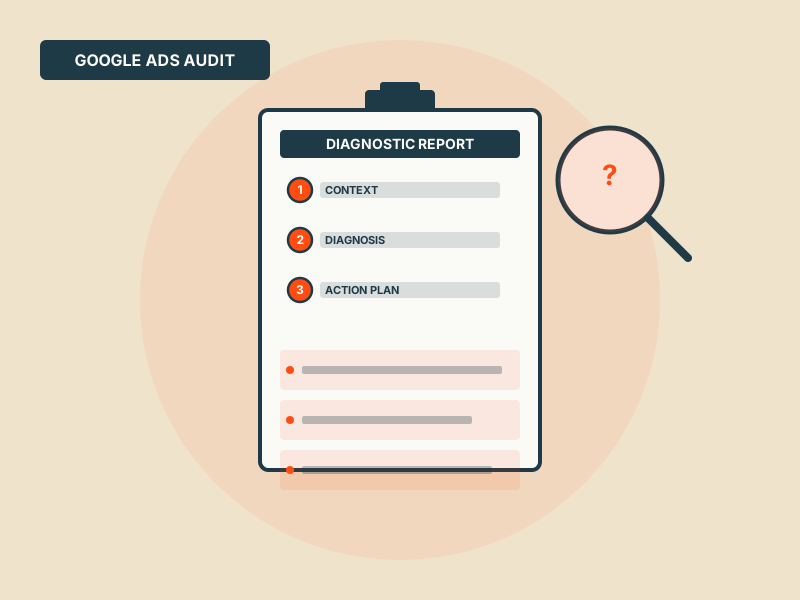
A proper audit has three stages, in order.
Stage 1: Context, understanding what a good result looks like
This is the stage the cosmetic audit skips. Before anyone looks at the account, you have to agree what the account is supposed to be doing.
- What is a genuinely good lead or sale worth to your business, net, after cost of delivery?
- What proportion of enquiries close? What's the average order value or deal size of the ones that do?
- What's the sales cycle, a click today, a deal this quarter?
- Where does Google Ads sit in your marketing mix? First-touch discovery, closing the deal, both?
- What's the budget doing at the business level, not the platform level (CAC vs LTV, blended, against organic)?
Without this, every downstream observation is just opinion. The same account can be "underperforming" or "running beautifully" depending on what you thought it was for.
Stage 2: Diagnosis, where the money is actually going
With context set, the auditor walks the account layer by layer against the thesis.
- Conversion schema, is the account measuring the right thing? Primary vs secondary conversions, Enhanced Conversions for Leads, offline sales import, value rules
- Bid strategy, matched to the conversion volume the account actually produces? Are we in "learning" or "learned"?
- Match types and search terms, what queries is the money going to? How much of the spend is on queries that should convert vs queries that never will?
- Campaign structure, do the campaigns correspond to business decisions you could actually make about each one?
- Ad-to-landing coherence, for the top 10 spending ad groups, does the ad promise line up with the first viewport of the landing page?
- Landing page performance, bounce rate, form completion rate, speed, form friction
- Attribution, what attribution model is the account on, and how is it mis-crediting work?
- Performance Max vs Search, are the two cannibalising, or properly segmented?
Most real audits surface three to six binding constraints, the things that, if changed, would move the account's numbers by a meaningful amount. Not 40. Usually under 10.
Stage 3: Prioritised action, what to do and in what order
The third stage converts diagnosis into decisions.
- What's the highest-leverage change you can make this week? Next week?
- What requires resources from elsewhere in the business (dev time for tracking, sales input for offline conversion import, pricing change for landing page)?
- What's the 30-day, 60-day and 90-day look like if the recommended changes are actioned?
- What's the expected improvement, and what assumptions does that depend on?
A cosmetic audit ends with a list. A diagnostic audit ends with a sequence.
When an audit actually pays back
Commissioning an audit costs time and usually money. It's worth it in these situations:
Performance has been drifting for 90+ days and nobody can explain why. Plate-shifting problems (seasonality, algorithm changes, new competitors entering the auction) need an outside pair of eyes because the person running the account day-to-day has adapted to the drift and stopped seeing it.
You inherited an account. The person who built it is no longer involved. You don't know which decisions in the structure are deliberate and which are leftover from an earlier thesis. An audit maps the account to the current thesis and flags the mismatches.
Spend has crossed a threshold, typically £5k+/month. Below that, the account is usually small enough that you (or someone in-house) can rebuild intuitively. Above that, small structural issues compound into five-figure annual waste. Audits find the waste.
You're considering changing agencies or going in-house. An independent audit gives you a baseline against which to measure the new team. Without one, it's hard to tell whether performance changes after the switch are due to the new team or just Q-over-Q noise.
You're about to scale the budget up significantly. Spending more on a well-structured account produces more conversions. Spending more on a leaky account produces more waste. Audit first, scale second.
When an audit won't help
- The account is less than 90 days old, not enough data to diagnose
- Total spend is under £2k/month, structural issues aren't expensive enough yet to justify the exercise
- The problem isn't ads; it's offer/market fit (ads can't fix an offer nobody wants)
- You've already had an audit in the last 6 months and actioned most of the findings, the marginal return from another one is low
What to ask an auditor before hiring them
Five questions that separate the two types of audit:
1. "How will you learn what a good lead is worth to us before you start?", Cosmetic auditors don't need this. Diagnostic auditors won't start without it. 2. "Will you look at our search-terms report in detail, or just aggregate metrics?", Search-terms detail is where most of the waste is visible. 3. "Will you make recommendations about our conversion tracking setup, or just take it as given?", If they don't touch tracking, half the account is invisible to them. 4. "What does your deliverable look like, findings list or prioritised action plan?", Checklist vs sequence is the tell. 5. "Do you want a call with our sales team or access to closed-deal data?", Diagnostic auditors will usually ask for this unprompted.
If all five answers lean toward the cosmetic end, save the money and just run through Google's own Recommendations tab.
How we run ours
Our free Google Ads audit is a diagnostic audit, delivered as a call plus a written report. It starts with a 30-minute context conversation about what a good result looks like in your business, then a three-day review of the account, then a write-up with a ranked action list, what to do this week, this month, and this quarter. No slide deck, no pitch. If there's a fit for further work, we'll tell you. If there isn't, the report is yours and you're done.
Fill in the form and we'll come back within one working day.
Get a free PPC audit from the team that wrote this.
We'll review your Google Ads or Microsoft Ads account and show you three specific things we'd change in the first 30 days.