
Hiring a Google Ads consultant in London, 5 things that only matter at this auction level
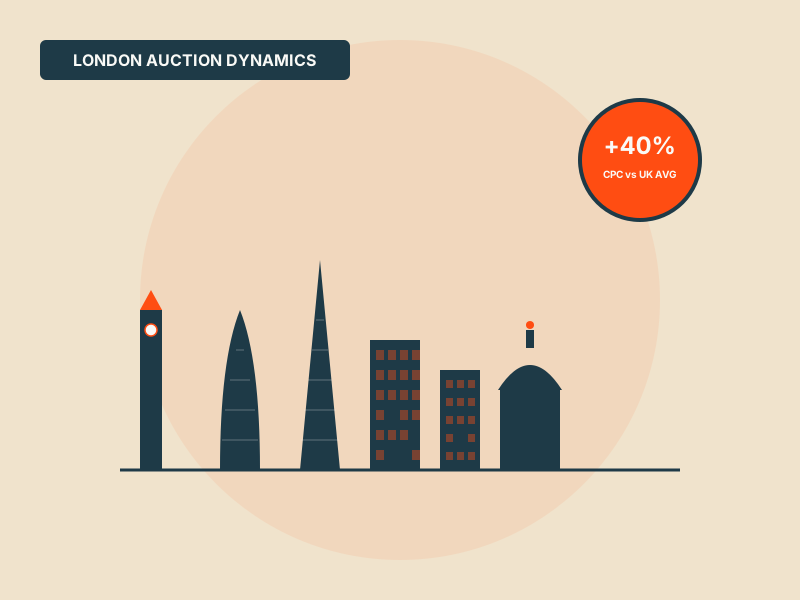
London CPCs run 30–60% above the UK average. The playbook that works in Manchester or Birmingham quietly falls over at London prices. What to look for in a consultant who actually operates at this level.
London is the most expensive Google Ads auction in the UK. Across most B2B categories, CPCs run 30–60% higher than equivalent queries in Manchester, Birmingham or Leeds. For high-ticket professional services (legal, financial, proptech, B2B SaaS) the London premium goes higher still.
That economic gap matters when hiring. A consultant whose track record was built on £0.80 CPCs in a regional market will quietly fall apart at £3.50 CPCs in central London, the same mistakes that cost a few hundred pounds a month elsewhere cost a few thousand here, and the same campaign structures that worked at regional scale leak 25–40% of the budget inside a London auction.
If you're a London-based business hiring a Google Ads consultant, these five things matter more than the generic "has they got certifications" list.
1. They understand CPC-driven account structure
Every structural choice in a London Google Ads account is distorted by expensive clicks. A £1,000 weekly budget buys 1,000 clicks in Manchester or 300 clicks in Westminster. That changes everything about how the account needs to be built.
What a London-experienced consultant does differently:
- Smaller, tighter ad groups. With fewer total clicks to distribute, every click needs to land on a perfectly matched ad. A consultant used to cheaper markets will let ad groups bloat to 30–40 keywords. In a London account that's a direct route to budget-burn.
- Conservative match-type use. Broad match in a high-CPC market is a fast way to burn a month's budget on irrelevant queries. London accounts typically use exact and phrase match for the core, with broad limited to well-controlled discovery campaigns and tight negative lists.
- Brand-first defence. London is a more competitive auction. Competitors bid on your brand terms more aggressively. Defending brand search typically needs a dedicated high-priority campaign with its own budget line, not brand terms buried in a larger campaign.
Ask: "How would you structure the account differently for a London-based business vs a Midlands-based one at the same budget?" The consultant should have a real answer.
2. They treat Performance Max with London-level caution
Performance Max is powerful but expensive to let off-leash. In high-CPC markets it can burn through budget on broadly-relevant-but-not-converting queries faster than in lower-CPC markets, simply because each mistake costs more.
London-experienced consultants typically:
- Run Performance Max in tightly-scoped asset groups by intent, not one catch-all group
- Exclude brand terms aggressively via account-level negative lists applied to Pmax
- Monitor the Search Terms Insights report weekly (not monthly) because a week of wasted spend hurts more when CPCs are high
- Hold Performance Max to higher ROAS thresholds before scaling budget to it
Ask about their Performance Max management cadence. Weekly review is the London-level standard. Monthly is regional-market thinking applied to a different market.
3. They're comfortable with small-volume, high-value conversion signals
Many London-focused businesses, legal practices, wealth managers, B2B sales teams, specialist consultancies, have low conversion volume but high conversion value. A single closed deal might be worth £30,000. The account does 3–5 conversions a month.
Low-volume accounts break smart bidding algorithms unless the consultant knows what they're doing. Target CPA and Target ROAS need 15–30 conversions/month per campaign to stabilise. Below that, they thrash.
A London-experienced consultant:
- Uses offline conversion import aggressively, because pipeline data is the only way to get from low click-volume to trustworthy optimisation signals
- Keeps campaigns consolidated rather than splitting too aggressively, ten campaigns each doing 2 conversions is a structural disaster
- Uses Conversion Value Rules to signal "this closed lead is worth £30k, not £0" when the platform only sees a form submission
- Holds off switching from Maximise Conversions to Target CPA until the campaign is earning the right to run on targets
Ask about their experience with low-volume, high-value conversion signals. If they've only worked on e-commerce with hundreds of daily transactions, they're going to apply the wrong playbook to a professional-services account.
4. They have a view on the London auction landscape
Who's bidding in your auction matters. Auction Insights will tell you the names, but it takes a consultant who watches the space to tell you what those names mean strategically.
A London-experienced consultant will know:
- Which large-scale UK agencies run multiple clients in your category (so the auction behaviour might correlate across them)
- Which London-based competitors are themselves buyer-side or in-house (and likely to have smaller but smarter teams)
- Which auction participants are consistently present vs. which appear only during sale periods or campaign launches
- Whether the category has big-brand incumbents with huge defensive budgets (in which case mid-budget challengers need very different tactics from category-leader budgets)
This isn't Google Ads platform knowledge, it's market knowledge. A consultant with no view on the landscape is running the auction blind in the most expensive market in the country.
5. They know when London isn't the right market
The uncomfortable answer: for some businesses, London is the wrong place to spend Google Ads budget. Too expensive, too competitive, with better-served alternative regions elsewhere in the UK.
A consultant who's operated at the London level will, occasionally, tell a client: "We should be running less of your budget here. Target the Thames Valley, target the Home Counties, target Manchester where you have a second office, your CPAs there will be 40% lower for the same business outcome."
That's the kind of advice that only comes from someone who's worked across London and non-London accounts and has the economic comparison to make. A consultant who's only ever operated in London will assume London-level spend is always right. It isn't.
Ask: "Are there parts of our target market where we shouldn't be focusing Google Ads budget, and how would you know?"
The single most useful test
For a consultant you're considering hiring, the single most useful test is to show them Auction Insights from your current account and ask for a 10-minute opinion.
If they look at it and have an informed view, this competitor is defensible, that one is beatable, these two are running the same agency and the auction behaviour correlates, the impression-share gap here is actually a pricing story not a budget story, they're operating at the level you need.
If they look at it and say "yes, looks competitive", they're not.
If you'd like that test with us
WMI is a London-based Google Ads consultancy. We run accounts with daily spend into four figures in central London auctions, we spend a lot of time looking at Auction Insights, and we're happy to run the test above for free as part of a free Google Ads audit. You'll get a useful conversation about your specific auction landscape; if there's a fit for working together, we'll say so.
Get a free PPC audit from the team that wrote this.
We'll review your Google Ads or Microsoft Ads account and show you three specific things we'd change in the first 30 days.