
Google Ads freelancer, what you get, what you miss, and the 5 ways bad ones blow up accounts
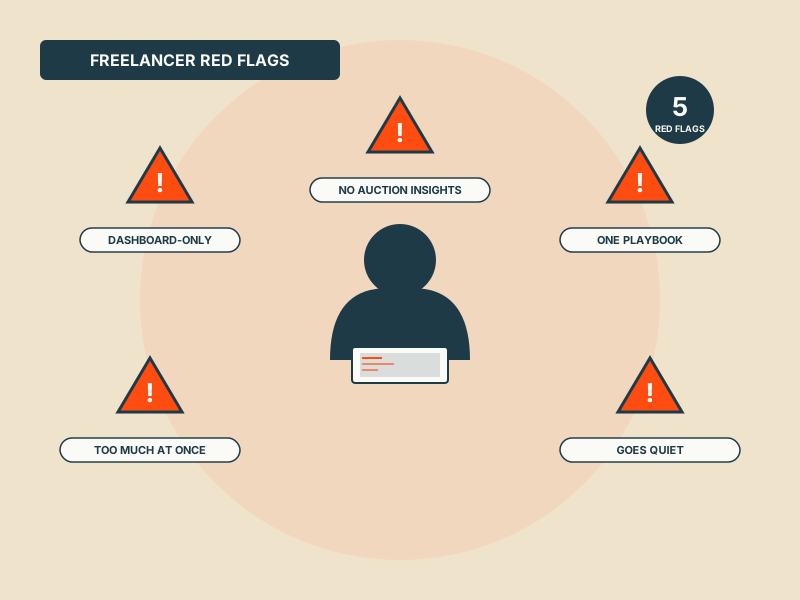
Freelancers are the lowest-friction way to get Google Ads help. They're also the highest-variance. The patterns that separate the ones who save your account from the ones who quietly sink it.
A Google Ads freelancer is the easiest and cheapest way to get someone working on your account. It's also the highest-variance. A genuinely good freelancer can deliver equivalent work to an agency retainer at half the cost; a poor one can do damage that takes six months to recover from.
The difference isn't platform certifications, LinkedIn claims or project portfolios (which are easy to inflate). It's a small number of structural warning signs that show up in how they work, not in how they present themselves. After running a few hundred freelancer audits, these are the five failure patterns that show up most often.
1. They optimise for the dashboard, not the business
The commonest freelancer failure mode isn't laziness; it's optimising toward the wrong thing.
A freelancer whose only visibility into the account is what Google Ads shows them will optimise toward: CPA, conversion count, ROAS based on Google Ads' own attribution. Those numbers move. The dashboard looks better each month. They report success.
Meanwhile at the business level: closed deals aren't rising, blended CAC is drifting up, the sales team starts complaining about the quality of leads. The freelancer is doing real work and the numbers on their screen are improving, but the business isn't.
The fix is feeding real business outcomes back into Google Ads (Enhanced Conversions for Leads, offline conversion import, Conversion Value Rules). A freelancer who doesn't push for access to your CRM data, doesn't ask about pipeline conversion rates, and optimises only against what Google shows them is on a trajectory toward this failure.
The test: ask in the first conversation "what data do you need from us to do this well?" A good freelancer will name three things, one of which is your CRM or sales data. A poor one will say "just Google Ads access".
2. They run the same playbook on every client
Freelancers who've built their practice on one account archetype, typically e-commerce with Shopping campaigns, or B2B lead-gen with Search, tend to apply that playbook to everything.
The symptom: they pitch you a campaign structure before they've looked at your account. They have a "standard setup" they apply to new clients. They have strong views about channel mix that seem to apply regardless of your category.
What's being missed: your business's specific auction landscape, conversion volume curve, seasonal patterns, sales cycle length. A playbook that works for £80 subscription box e-commerce won't work for £80,000 B2B enterprise deals.
The test: show them two of your competitors (which you've already analysed) and ask how they'd approach the account differently if you were trying to out-compete each. A freelancer running one playbook will struggle to give two different answers.
3. They don't know how to read Auction Insights
This one sounds technical but is surprisingly diagnostic. Auction Insights is a free, in-platform report that tells you what competitors are doing in your auction. It's the single best source of competitive context in a Google Ads account.
Freelancers who know it inside out:
- Check it weekly or fortnightly
- Can interpret impression share, outranking share, overlap rate together rather than just citing the raw numbers
- Notice patterns (new entrants, retreating competitors, seasonal swings) and adjust bids accordingly
- Use it to explain performance changes that would otherwise look like "the algorithm did something weird"
Freelancers who don't know it will treat every performance shift as an internal account issue and try to fix it by changing bids, creatives or structure, when the actual cause was a competitor entering or leaving the auction.
The test: at some point during the engagement, share an Auction Insights export (or screenshot) and ask "what does this tell us about our position?" A good freelancer will have specific observations within two minutes. A poor one will restate what the columns say without interpretation.
4. They change too many things at once
Experienced Google Ads operators change things slowly. Inexperienced ones change everything at once because they want to demonstrate activity.
What "changed too much" looks like:
- Restructuring ad groups, changing bid strategies, and adding new keywords all in the same week
- Enabling Performance Max at the same time as introducing new Search keywords
- Switching attribution models during a restructure
- Big, bold "optimisations" that touch 20 different parts of the account
This is bad because you lose the ability to attribute any performance change to any specific decision. If results improve, you don't know what worked. If results decline, you don't know what broke.
The test: in month one, look at what they did. Was it 3–5 specific, documented changes, with rationale? Or was it a sweeping re-do with no clear causal chain? The first is a freelancer who'll keep improving your account. The second is one who's burning your data on activity theatre.
5. They're only as available as the work in front of them
Freelance economics make this almost unavoidable: a freelancer who lands a big new client will reduce attention on the existing smaller clients. You may not find out about this until performance on your account starts drifting and you can't get a reply within 48 hours.
Signs this is happening:
- Responsiveness drops from same-day to two-day to three-day without any conversation about it
- Monthly reports start arriving late, or don't arrive at all
- Account changes become infrequent, the freelancer isn't doing the cadence they originally proposed, but isn't telling you
- You're the one chasing them rather than the other way round
This is the failure mode that's hardest to protect against in a freelance engagement, because the freelancer won't volunteer that they've de-prioritised you. You have to actively monitor for it.
The test: 90 days in, review: is the cadence matching what was agreed? Are changes being made at the promised frequency? If not, have the conversation early, either they re-commit to the original cadence, or you re-scope or end the engagement. Letting it drift is the way you get to a performance problem three months later that's hard to recover from.
Where freelancers genuinely win
The above isn't an argument against hiring freelancers. The good ones can deliver outstanding work:
- For accounts £3k–£15k/month spend, a good senior freelancer gives you one-to-one senior attention at a cost agencies can't match structurally
- For specialist situations, feed optimisation, Performance Max deep work, low-volume high-value conversion signals, a freelancer who's built their practice on that specific niche will often out-perform a generalist agency team
- For short-term sprints, launching a new region, rebuilding tracking, restructuring an account before a scale-up, a specialist freelancer on a 60-90 day engagement is often the right tool
The trick is matching the freelancer's actual strengths to the actual need, with clear-eyed view of the failure patterns above.
The hybrid model that's replacing pure freelance
One pattern that's gained ground since 2024: senior freelancers grouping into small 3-5 person consultancies that operate with a freelance-adjacent cost structure but without the bus-factor-of-one risk. You get continuity if one person is on holiday, more senior pairs of eyes on the account, but not the junior-heavy delivery model of a large agency.
This is what we do at WMI, small senior team, consultancy pricing, without the "account manager with 30 other clients" agency pattern.
If you'd like an independent read of what your current freelancer (or agency) is doing, book a free audit. The audit doubles as a way to stress-test the engagement, whatever model you're currently in, we'll tell you whether the work matches the fee.
Get a free PPC audit from the team that wrote this.
We'll review your Google Ads or Microsoft Ads account and show you three specific things we'd change in the first 30 days.