
Google Ads management in London, what an account in the UK's most expensive auction market needs
The management playbook that works at UK regional CPCs quietly falls over at London prices. What changes, in cadence, in structure, in reporting, when you're operating in the most expensive paid-search market in Britain.
A £20,000/month Google Ads spend in a London B2B category behaves differently from a £20,000/month spend in a Midlands B2B category. Same budget, same business goal, different auction economics, and therefore a different management discipline.
The generic "monthly retainer with quarterly strategy review" works in markets where a single poor week costs a few hundred pounds. In London it can cost a few thousand. That economic difference changes what "managing" a Google Ads account actually looks like.
Here's what proper Google Ads management looks like for a London-based account, and what to insist on from whoever's running yours.
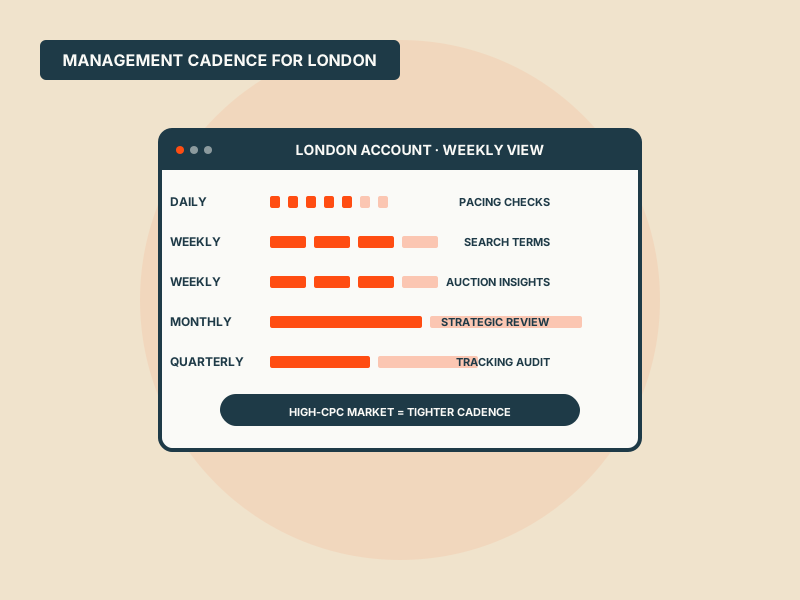
Weekly, not monthly, search-terms review
In a regional market running at £0.80–£1.50 CPCs, a monthly search-terms pass catches waste soon enough. A month of bad queries costs £200–£500 of leak, annoying, not business-threatening.
In central London at £3.00–£6.00 CPCs, the same month of bad queries costs £800–£2,500 of leak. That compounds quickly. Across a year, the difference between weekly and monthly search-terms cleanup is £5,000–£25,000 of recoverable spend.
Insist on weekly search-terms review as the default cadence. Any account manager who proposes monthly for a London account hasn't internalised the economics.
Daily pacing check (not weekly)
Budget overspend in Google Ads tends to happen in bursts. A bidding-algorithm spike, a sudden surge of competitor activity, a Performance Max asset group that starts running away with spend, these events concentrate into 24–48 hour windows.
At regional CPCs a 24-hour overspend event costs £100–£300 to correct. At London CPCs it can cost £500–£1,500. For service businesses with closing cycles long enough that you'll see the financial impact months later, catching these fast matters.
A well-managed London account has either a human or an automated rule checking pacing daily, with alerting if any campaign exceeds its daily budget by more than 20%. Weekly-only pacing checks assume regional economics.
Conversion tracking audit every 90 days, not "when something seems off"
Offline conversion import drift, Enhanced Conversions dropping due to a consent-mode change, a new GTM deployment that accidentally removes a firing tag, these are silent failures. The account keeps running; smart bidding keeps making decisions; you just can't see the real outcomes any more.
In a low-CPC market, two or three months of tracking drift is recoverable. The bidding algorithm will learn back on corrected data. In a high-CPC market, three months of smart bidding on broken signals can burn meaningful chunks of annual budget before anyone notices.
Proper London-grade management includes a scheduled 90-day tracking audit, check every conversion action is still firing correctly, check Enhanced Conversions coverage, check offline import is still running, reconcile Google Ads conversions against CRM closed deals. Quarterly. Calendar-scheduled, not "when it seems off."
Auction Insights review, not just performance review
Most monthly management reports show what happened inside your account. Few show what happened in the auction around your account.
Auction Insights (especially the "Change History" version that lets you compare periods) tells you:
- Which competitors increased their impression share against you
- Which ones entered the auction or left it
- Whether your outranking share moved because of changes you made, or because competitors did something
- Which auction positions cost what, and whether the marginal cost of going from position 3 to 2 is still worth it
In London, competitive dynamics move faster than in regional markets. A new entrant bidding aggressively can shift your unit economics in a week. Without Auction Insights review built into the management rhythm, you're responding to your own campaign's numbers without seeing what's happening in the space around you.
Spend-tier-appropriate escalation paths
A £3k/month London account run by an account manager with 30 other clients is structurally under-served. At London economics, £3k/month accounts tend to have complex enough auction dynamics that they need senior time, even if infrequent.
Good London-grade management has tiered escalation:
- Day-to-day ops, account manager, fast response times on tactical tasks
- Weekly account lead review, someone more senior looking at the week's decisions and adjustments
- Monthly strategic review, the person who made the original structural decisions, re-evaluating in light of the last 30 days
- Quarterly business review, cross-functional, with sales data and business direction as context
Smaller accounts don't need all four levels running at full intensity. But the escalation path needs to exist. "I'm the account manager and I handle everything" is fine in a lower-stakes market; in central London it means the one person handling your account is a single point of failure for your entire paid-search performance.
Offline conversion data is not optional
For every London B2B account we've audited, the single biggest performance lever has been getting offline conversion import, actual closed-deal values from the CRM, back into Google Ads.
Why this matters more in London: the £3,000 you paid to acquire a lead is only justified if enough of those leads close high-value deals. At regional CPCs, the margin for error on a low-close-rate campaign is higher. At London CPCs, a campaign optimising to form submissions rather than closed deals can look profitable on the dashboard while quietly losing money at the business level.
Management that ignores offline conversion data is accepting that the account is optimising toward something that isn't what you care about. At London prices, that accepts more waste than most businesses realise.
Any proper Google Ads management engagement for a London account should either set up offline conversion import at onboarding, or identify it as the single most important fix in the first 30 days.
What proper London-grade management costs
Rough market, 2026:
- £1,500–£2,500/month retainer for accounts spending £5k–£15k on media in London
- £2,500–£5,000/month for accounts spending £15k–£40k
- £5,000/month+ (or percentage of spend) for accounts above £40k/month spend
Below £1,500/month of management fee, you're buying regional-market service levels applied to a London account. That's the version of the service that quietly under-delivers, not because the people are bad, but because the cadence doesn't match the economics.
If you'd like a second look at your London account
We run a free Google Ads audit built specifically around the economics of higher-CPC markets. 30-minute scoping call, 3 days of review, written report with prioritised actions. No sales pitch attached, if the current agency or consultant is doing the right work at the right cadence, we'll tell you that too.
Get a free PPC audit from the team that wrote this.
We'll review your Google Ads or Microsoft Ads account and show you three specific things we'd change in the first 30 days.