
Google Ads management for UK businesses, the country-specific things that change the playbook
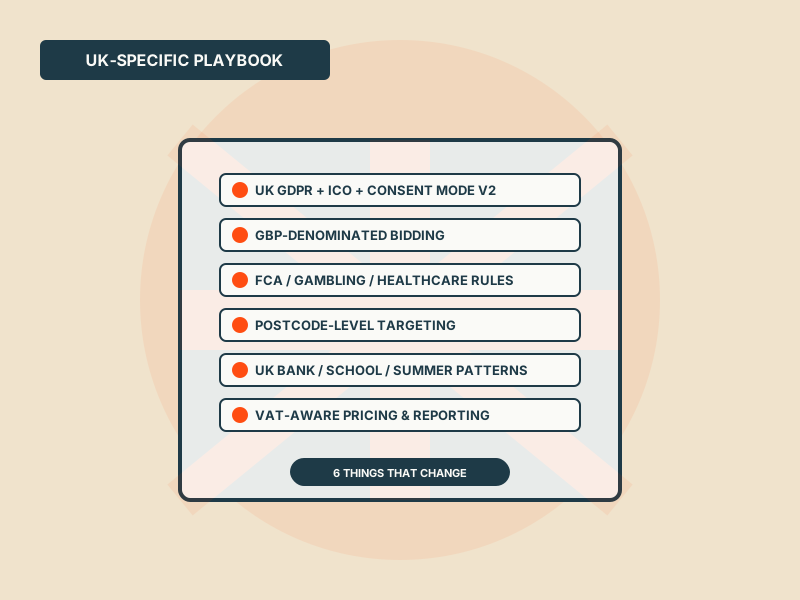
A US-built playbook applied to a UK Google Ads account quietly leaks performance. Six things that work differently here, and a manager who doesn't know them is running with last year's manual.
Most Google Ads "best practice" content is written for the US market. The platform features may be the same, but the auction economics, the regulatory framework, and the buyer behaviour around UK accounts are different enough that a US playbook applied unmodified leaves performance on the table, sometimes a lot of it.
If you're hiring or evaluating a Google Ads manager in the UK, the things below are what they should treat differently. A manager who runs a UK account exactly like a US account is doing 70% of the job.
1. Consent Mode v2 and ICO/UK GDPR compliance
The UK runs its own GDPR (UK GDPR, post-Brexit), enforced by the ICO. The cookie-consent regime is functionally the same as EU GDPR for most purposes, but the enforcement style and recent guidance differs.
What this means in practice for Google Ads:
- Consent Mode v2 is non-negotiable for any UK account that uses smart bidding, Enhanced Conversions, or remarketing audiences. Without it, conversions go uncounted for users who decline marketing cookies, and bidding signal degrades.
- EEA/UK consent banners need to capture both ad-storage and analytics-storage consent separately. A US-style "by using this site, you accept cookies" banner is not compliant and is increasingly being challenged.
- Customer Match list uploads require a documented lawful basis under UK GDPR. "We had a customer relationship with these people" doesn't always qualify if the original opt-in didn't anticipate ad targeting.
A UK Google Ads manager should be able to discuss Consent Mode v2 setup, sign-off on banner compliance, and the ICO's recent guidance on programmatic advertising data processing. If they can't, they're running with US instincts on UK data law.
2. GBP-denominated bid economics
UK auctions price in pounds. Smart bidding optimises against the conversion values you feed it. If your CRM exports values in dollars or euros and the Google Ads account is in GBP, currency-conversion drift will quietly distort your bidding signal.
Common pattern: a UK SaaS business sells globally, its CRM denominates everything in USD, but the Google Ads account is GBP-only. Smart bidding sees inconsistent value-per-conversion as the FX rate moves, optimises poorly, and the account drifts.
Fix: pick one currency, denominate offline conversion imports in that currency, and document the conversion logic. A UK manager should ask about this before running the account for any business that does cross-border revenue.
3. Regulated-sector advertising rules
Several UK industries have specific Google Ads compliance requirements that don't match US rules:
- Financial services, must be FCA-authorised (or have approval from someone who is) to advertise consumer credit, investments, certain insurance products. Google verifies this; ads will be disapproved without it.
- Gambling, UK Gambling Commission licence required. Whitelisting is a multi-week process, and anti-promotion rules around bonus advertising apply differently to UK accounts.
- Healthcare, pharmacy and pharmaceutical advertising is more restricted in the UK than in some other markets. Prescription drugs cannot be advertised to consumers; OTC and pharmacy-listed products have specific creative requirements.
- Cryptocurrency / financial trading, restrictive Google Ads category in the UK; full FCA registration required. Many crypto-related accounts that would run in the US can't run in the UK.
A manager who's only worked in lighter-regulated US categories may not know these. If you're in any of these sectors, ask explicitly about their experience with UK regulatory compliance for Google Ads in your specific category.
4. Postcode-based location targeting
UK postcodes are more granular than US zip codes, a single London postcode can cover one street. This makes hyper-local campaigns more precise but also more fragile.
What works in the UK that wouldn't necessarily transfer:
- Postcode-area targeting (e.g. "EC1V") rather than radius targeting around a city. Maps to actual market-area boundaries more accurately.
- Multi-postcode-area campaigns for service businesses with delivery zones, splitting EC1, WC1, N1 etc. into separate campaigns for delivery-fee differences.
- Postcode-based negative location lists to exclude specific areas where you don't operate (or where conversion rate is historically poor).
US managers used to ZIP code/DMA targeting may not realise the precision available. Conversely, they may over-target, UK postcode areas can be smaller than their US equivalent and underbidding follows.
5. Bank holidays, school holidays, and seasonal patterns
UK seasonal patterns don't match US ones:
- Bank holidays (8 in England/Wales, 9 in Scotland), different dates from US federal holidays, similar effect on B2B but different on B2C
- School holidays in the UK split differently, half-term breaks (every 6-8 weeks) plus summer (6 weeks vs US 8-12), Easter (movable), Christmas (2 weeks)
- Summer slowdown in B2B is more pronounced in UK/Europe than in US, July-August are noticeably softer
- Pre-Christmas e-commerce ramps earlier in the UK (mid-November vs late-November in US) and Black Friday has different dynamics
A US-based manager working on a UK account may keep budgets steady through periods where they should be flexed up or down. Same goes for bid-strategy holidays, Target ROAS during a UK summer slowdown will under-perform unless adjusted.
6. Currency, VAT, and reporting transparency
A few practical reporting things that matter for UK businesses:
- Google Ads reports in GBP excluding VAT. UK invoices include VAT. Reconciliation is a thing.
- Pricing communication in ad copy: UK prices are usually shown VAT-inclusive (B2C) or VAT-exclusive (B2B). Mixing the two between ads and landing page is a conversion-rate issue.
- Phone-call conversions: UK numbers vs US numbers behave differently in click-to-call conversion tracking. Make sure tracking is configured for UK Google Forwarding Numbers (or a third-party call-tracking provider that supports UK numbers).
These are small things individually. Together they're the difference between an account that runs cleanly and one where every monthly review needs explaining.
What this means when hiring
If you're a UK business hiring or evaluating a Google Ads manager, the test is not "can they run Google Ads", it's "have they internalised the UK-specific differences". The questions to ask:
- "How would you set up Consent Mode v2 for our site, and what are the gotchas?"
- "What's your view on the ICO's recent guidance on programmatic advertising and what does it change in our setup?"
- "How do you handle the seasonal patterns of summer slowdown in B2B, and the UK Christmas e-commerce ramp?"
- (If applicable to your sector) "Have you worked with FCA-authorised / Gambling-licensed / healthcare-restricted Google Ads accounts before? Walk me through the setup."
A manager who treats these as edge cases is running a US playbook. A manager who treats them as core configuration is running a UK playbook.
Where this fits in our practice
WMI is a UK-based Google Ads management consultancy. Every account we run is UK GDPR-compliant from the start (Consent Mode v2, lawful-basis review for Customer Match, ICO-aligned data handling). For accounts in regulated sectors (FCA, GC, healthcare) we either have direct experience or co-ordinate with the client's compliance team before any campaign goes live.
If you'd like a UK-specific review of your current Google Ads setup, book a free audit. The audit is structured around the UK-specific points above as well as the standard performance review.
Get a free PPC audit from the team that wrote this.
We'll review your Google Ads or Microsoft Ads account and show you three specific things we'd change in the first 30 days.