
Performance marketing agency, what the term actually means and why most "performance marketing agencies" aren't
"Performance marketing" got hijacked as a marketing label. The real discipline is narrower, more measurable, and harder than most agencies claiming the title actually do. A clarification.
"Performance marketing" has become one of the most overused labels in the agency market. Search "performance marketing agency UK" and you'll find dozens of agencies that are functionally Google Ads agencies, paid-social agencies, or general-purpose digital agencies, all wearing the same label. The label has been hijacked from its original meaning, which was specific and demanding.
If you're hiring a "performance marketing agency", knowing what the term actually means, and what it doesn't, saves you from buying execution capacity dressed up as strategic outcomes work.
What performance marketing actually is
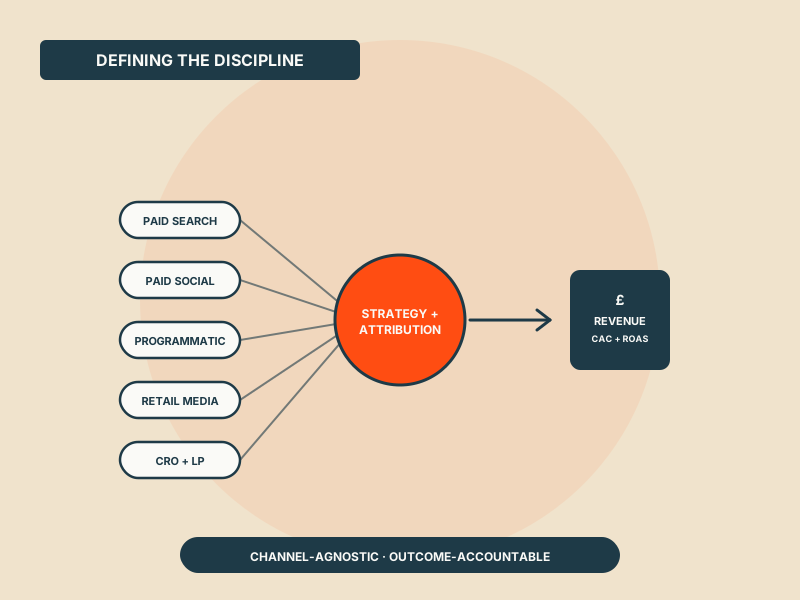
Performance marketing, properly defined, is a discipline where the agency owns business outcomes (revenue, leads, customers acquired) rather than channel outputs (clicks, impressions, ROAS-on-platform). The work is measured by what happens in your business, not by what happens in the ad platform.
Two things distinguish it from adjacent disciplines:
1. Outcome accountability. A performance marketing agency commits to a business KPI, typically CAC, blended ROAS, or revenue contribution. They get paid based on hitting it (or have skin in the game some other way). They don't define success by "Google Ads ROAS" or "Meta CPA" because those are channel metrics, not business metrics.
2. Channel-agnostic strategy. A performance marketing agency uses whichever channel serves the outcome, not whichever channel they specialise in. If your CAC is best at £80 on TikTok and £120 on Google, they shift budget to TikTok. A Google-Ads-only agency can't credibly do this; a paid-social-only agency can't either.
Within those two constraints, the work spans:
- Paid acquisition across channels (search, social, retail, programmatic, sometimes affiliate)
- Conversion-rate optimisation on landing pages
- Attribution and measurement infrastructure
- Sometimes lifecycle / retention work (email, SMS, retargeting strategy)
A genuine performance marketing agency does most of this. A nominal one does paid acquisition on 1-2 channels and calls it "performance marketing" because the term has cachet.
How "performance marketing" got hijacked
Three things happened in the last 5-7 years:
1. Direct-response agencies rebranded. Agencies that used to call themselves "direct-response" or "DR agencies" rebranded as "performance marketing" because the term sounded more sophisticated. Many didn't expand their actual scope, they just changed the label.
2. Single-channel specialists adopted the label. Google Ads agencies and paid-social agencies started calling themselves "performance marketing" to position against generalist digital agencies. They are performance-marketing-adjacent (they do measure conversions and optimise to CPA/ROAS) but they're not channel-agnostic.
3. Marketing-procurement pressure. Buyers increasingly want "performance accountability" and price the term into RFPs. Agencies of every shape started claiming it because losing pitches over a label is bad business.
The result: the label is everywhere, the discipline is rare.
How to test whether an agency is genuinely performance marketing
Five questions that surface the difference:
1. "What's the outcome KPI we'd agree to and how do you want to be paid against it?"
A real performance marketing agency will engage seriously with this. They might propose hybrid pricing: retainer plus performance bonuses tied to a specific business KPI (CAC under £X, blended ROAS above Y, revenue contribution of £Z). They'll have done this before and have contract templates.
A nominal one will either resist (preferring flat retainers tied to channel work) or propose theatrics, bonuses tied to platform metrics rather than business ones.
2. "How would you decide whether to add or remove a channel?"
Real answer: based on incremental impact on the business KPI. They'd describe a process for testing channels, measuring incrementality, and making the cut/keep call.
Nominal answer: based on what they're set up to deliver. *"We'd add Meta because we have a strong creative team"*, that's about their capacity, not your outcome.
3. "What's your view on attribution for our category?"
Real performance marketing agencies have strong opinions about attribution because attribution is what tells them whether their work is paying off. They'll talk about multi-touch attribution, mixed-media modelling, holdout testing, and the trade-offs between them. They can describe how attribution shapes their bid strategy across channels.
Nominal answers: either "we use Google's data-driven attribution" (just defaulting to platform) or generic statements about "marketing attribution" without specifics.
4. "Show me a client where you recommended cutting a channel."
Real performance marketing agencies have these stories. They can name clients where they cut budget on a channel because it wasn't performing, including channels they were running themselves.
Nominal ones don't, because cutting channels they run is cutting their own fee.
5. "How would you measure incrementality on our brand-search spend?"
Brand search is a classic test of performance marketing maturity. The honest answer is some version of: *"We'd run a holdout test, pause brand bidding for 2-4 weeks in some geos, measure organic + direct traffic recapture, calculate true incremental contribution."* This is uncomfortable for agencies because brand search usually shows good ROAS in platform reporting, and incrementality testing often shows it's less incremental than the platform suggests.
Nominal agencies either don't engage with the question or give surface-level answers about brand-search ROAS being a vanity metric without proposing how to measure incrementality.
What's NOT performance marketing despite the label
A few things you'll see in agency pitches that aren't performance marketing even if claimed:
- A Google Ads agency that also runs Microsoft Ads. That's a PPC agency, not a performance marketing agency. The scope is broader than Google-only but still single-discipline (paid search).
- A paid-social agency that runs Meta + LinkedIn + TikTok. That's a paid-social agency. Different discipline from paid search; also not performance marketing on its own.
- A "digital marketing agency" that adds attribution dashboards. Dashboards are reporting, not outcome accountability. Performance marketing requires committing to outcomes, not just measuring them.
- An agency that promises ROAS targets without owning channel mix. ROAS in Google Ads is a platform metric. Real performance work happens at the level of blended business KPIs across channels.
When you actually need a performance marketing agency
Despite the label being abused, genuine performance marketing agencies exist and are the right fit for some businesses:
- Multi-channel paid acquisition at scale (£25k+/month total paid budget across at least 3 platforms)
- Direct accountability for business outcomes, not just channel metrics
- Complex attribution, long sales cycles, multi-touch journeys, offline-online overlap
- Need for someone above the channel level, strategic decisions about where to invest, when to test new channels, when to cut
If your account is at this scale and complexity, a performance marketing agency is probably the right shape. Below that scale (£3-25k/month, 1-2 channels), you usually want a specialist in your primary channel instead.
Where we sit
WMI is not a performance marketing agency. We're a paid-search specialist consultancy, Google Ads + Microsoft Ads + tracking. The reason for the choice: we'd rather be excellent in one discipline than average across five. Most accounts at our typical size (£3-30k/month paid spend) get more value from depth in their primary channel than from cross-channel breadth.
We work alongside performance marketing agencies and consultancies on multi-channel accounts, often as the paid-search specialist within their broader programme. If your situation needs a true performance marketing partner, we'll point you to ones we trust. If you need paid-search depth specifically, book a free audit.
Get a free PPC audit from the team that wrote this.
We'll review your Google Ads or Microsoft Ads account and show you three specific things we'd change in the first 30 days.