
PPC agency vs Google Ads agency, when single-channel and multi-channel scope each pay
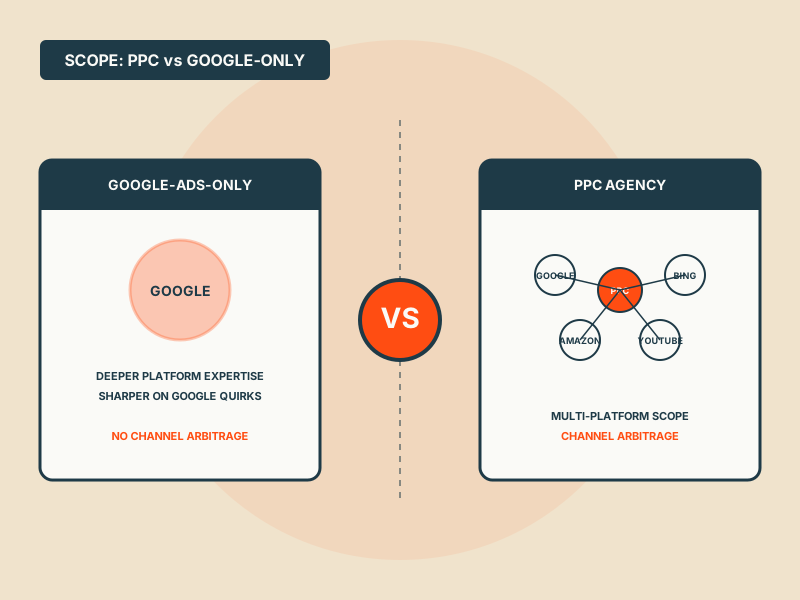
They sound similar; they're not. A PPC agency runs multiple paid-search platforms; a Google Ads agency runs one. Picking the wrong scope for your account is one of the quieter buying mistakes.
The terms get used interchangeably, but they shouldn't be. A "PPC agency" runs multiple pay-per-click platforms, typically Google Ads, Microsoft Ads, sometimes paid social where it overlaps. A "Google Ads agency" runs one. The scope difference looks small in the pitch and matters a lot in the outcome.
If you're a buyer trying to decide which to hire, and you're not sure of the difference, here's what each scope actually buys you and where the boundaries genuinely matter.
What "PPC" usually includes
In 2026 UK market practice, "PPC", pay-per-click, is the umbrella term for paid platforms where advertisers bid on placements and pay per click or per impression with a cost-per-click model. The list usually includes:
- Google Ads, Search, Performance Max, Shopping, YouTube, Discovery
- Microsoft Advertising, Bing Search, Audience Network, LinkedIn Profile Targeting
- Sometimes Amazon Ads (for retail/e-commerce specifically)
- Sometimes paid social search-equivalents (LinkedIn lead-gen forms, Pinterest)
A "PPC agency" should be running at least Google Ads + Microsoft Ads as default. Some extend further. The more platforms inside the scope, the more "PPC agency" the agency is, vs being a single-channel specialist.
What a Google Ads-only agency does that a PPC agency doesn't
Specialism, mostly. A Google-Ads-only agency goes deeper on Google's specific quirks: Performance Max asset-group experimentation, advanced conversion-tracking schemas, the latest match-type behaviour, audience-signal strategies that only matter inside Google.
For accounts where Google Ads is 80%+ of paid spend and the playbook needs to be sophisticated, a Google-Ads specialist will out-execute a PPC generalist on Google specifically. The depth of the bench is the difference.
What a PPC agency does that a Google-Ads-only agency can't
Channel arbitrage. The single biggest practical advantage of a PPC scope: the agency can move budget between platforms when one's economics shift, and capture the cheaper auction.
When Google CPCs spike on a head term and Microsoft is still cheap on the same query, a PPC agency moves spend. A Google-Ads-only agency keeps paying the higher Google price because the alternative isn't in their scope.
Microsoft Ads in particular is consistently underpriced relative to Google in B2B categories, typically 30-50% lower CPCs at the cost of 3-10x lower volume. For accounts where the volume is enough, the savings are material. A PPC agency captures this; a Google-Ads-only one doesn't.
The other channel-arbitrage moves:
- LinkedIn Profile Targeting layered on Microsoft Search for B2B, only Microsoft can do this, and it's only worth doing if your agency knows it exists and how to set it up
- Amazon Ads for retail taking spend that would otherwise go to Google Shopping when Amazon's CPCs are lower for a specific category
- YouTube vs paid-social video, different auctions, can be played against each other
When you should hire each
Google-Ads-only agency / consultant, when:
- 90%+ of your paid spend is on Google Ads and likely to stay that way (e.g. local services, single-platform B2C)
- You need depth on a specific Google product (Performance Max specialist for catalogue-driven e-commerce, app-install specialist for mobile)
- You have your own team running Microsoft Ads, paid social, etc. and need a dedicated Google specialist to slot alongside
- Your account is large enough (£20k+/month on Google) that depth in one platform compounds
PPC agency, when:
- You're spending on Google AND Microsoft AND want them coordinated
- B2B with target audience that uses both Google and Bing as work tools (most enterprise SaaS)
- You're running cross-channel paid programmes and want one team owning the unified strategy
- You don't have in-house resource to manage multi-channel and need it consolidated under one provider
- Your category has known channel-arbitrage opportunities (Microsoft cheaper than Google, Amazon cheaper than Shopping)
Neither, when:
- Total paid spend under £3k/month, you're better with a freelancer or consultant than any agency
- Your business is genuinely single-platform (e.g. only TikTok Ads, only Pinterest), neither a PPC nor Google agency is the right fit; you need a platform specialist
The pitch question that surfaces real scope
If an agency claims to be a "PPC agency", ask: "Walk me through your last Microsoft Ads test. What did you learn that would apply to our account?"
A real PPC agency will have a recent Microsoft test, they're running Microsoft constantly across their book. They'll have lessons that read like real operating insight: *"We found in Q1 that Microsoft Search CPCs in financial services are running 40% below Google. Worth running 10-15% of budget on Microsoft as long as the audience is professionally-skewed."*
A nominal "PPC agency" that mostly runs Google will have either no answer or a generic textbook answer. They'll talk in abstract about Microsoft's potential without specific recent data. That tells you Microsoft is on their service menu but not in their daily operating practice.
The pricing pattern
PPC-agency pricing usually runs 15-30% higher than Google-Ads-only equivalents at the same spend level, the team has more skills, more platform certifications, more complexity to manage.
If the PPC-agency pricing is at parity with Google-Ads-only pricing, ask why. Either they're running loss-leader pricing on the multi-channel scope, or the multi-channel scope is hollow (the agency is fundamentally a Google shop with Microsoft as an afterthought).
Where we sit
WMI is a PPC consultancy, Google Ads and Microsoft Ads, both at depth, plus the tracking and attribution work that ties them together. We don't do paid social. The reason for the scope choice: search-intent advertising is its own discipline; paid social is a different one. Mixing them means doing both averagely. We do search at depth.
For accounts where Google + Microsoft is the natural scope, we're the right shape. For accounts that need paid social heavily, we're not. If you'd like a UK-specific PPC audit covering both Google and Microsoft, book a free audit, we'll cover both channels from the start, not as an afterthought.
Get a free PPC audit from the team that wrote this.
We'll review your Google Ads or Microsoft Ads account and show you three specific things we'd change in the first 30 days.