
Performance marketing consultant, when fractional senior strategy beats hiring an agency or in-house lead
A performance marketing consultant fits a specific gap: senior cross-channel strategy without the cost of a full-time CMO or the bureaucracy of an agency. Here's when that gap is real.
There's a specific business gap that neither agencies nor in-house hires fill cleanly: senior performance-marketing strategy that doesn't need a full-time person but does need someone with cross-channel experience and authority to make hard decisions. A performance marketing consultant, fractional, senior, channel-agnostic, fills it.
If you're trying to figure out whether you need a consultant rather than an agency or an in-house lead, here's the honest framework. Sometimes the consultant is the right answer; often it isn't.
What a performance marketing consultant actually does
Properly defined, a performance marketing consultant operates at one of three levels above the channel-execution work:
1. Strategic, channel mix and budget allocation.
Decides where the budget goes, when to add or cut channels, what the right blended CAC target is, how to balance acquisition vs retention spend. Doesn't usually run the campaigns themselves; advises whoever does.
2. Measurement, attribution and analytics infrastructure.
Owns the question "what's actually working?" Sets up multi-touch attribution, runs incrementality tests, decides when MMM (mixed-media modelling) is worth investing in. Translates dashboard numbers into business-decision quality data.
3. Operating, running the performance function as fractional CMO.
Embedded in the business 1-3 days a week, owning the performance outcome at exec-team level. Manages relationships with whatever execution providers exist (agencies, in-house team, freelancers). Reports to CEO/CMO. This is the most senior version.
Different consultants operate at different levels. The best ones can flex between layers depending on what the business needs that month.
When the consultant model fits
Five situations where a performance marketing consultant is the right answer:
1. You have execution capacity but need senior strategy above it.
You've got a Google Ads agency, a paid-social agency, an in-house ops person, but no-one above them coordinating the whole performance-marketing programme. The execution gets done; the strategy drifts.
A consultant 4-8 hours a week can sit above the execution providers, set the cross-channel strategy, and make sure they're rowing the same direction. Cost: £2-6k/month. Cheaper than the alternative (a full-time Head of Performance at £80-120k/year).
2. You're between performance-marketing leaders.
Your Head of Performance left. Hiring a replacement takes 3-6 months. In the gap, the function drifts. A consultant on a 90-180 day engagement holds the function together while you recruit, then hands over to the new hire.
3. You're testing whether to invest in the function in-house.
You're not sure performance marketing deserves a full-time exec hire yet. A consultant can run it for 6-12 months, prove out (or disprove) the value, and either hand over to a hire later or scale up to a permanent fractional arrangement.
4. You need specialised attribution work.
You've got a tactical team running campaigns but no-one with deep enough attribution expertise to set up the measurement infrastructure. A consultant on a 60-90 day project sets up the measurement (server-side tagging, MMM, incrementality testing programme), trains the team, and exits.
5. You're scaling and need senior pattern-recognition.
You're growing fast, your CAC is drifting up, and you don't know whether it's a strategy problem, a channel problem, or just the natural cost of scale. A consultant who's seen this pattern before can diagnose it in 2-3 weeks. Hiring an agency to do this is overkill; hiring an exec is too slow.
When the consultant model doesn't fit
The flip side. A consultant is the wrong answer when:
You need execution, not strategy. If you don't have anyone running campaigns and need someone to actually do the work, a consultant is the wrong shape. Hire an agency, a freelancer, or an in-house ops person.
You need 5-day-a-week presence. Consultants are by definition fractional. If your performance function genuinely needs daily attention from a senior person, hire one full-time.
The decision-making authority matters. Some businesses need their performance lead to be an employee with formal authority (signing contracts, hiring junior team, being accountable to the board). A consultant can't always give you that.
Your spend doesn't justify it. Below £15k/month total paid spend, the consultant fee is a meaningful chunk of the budget. Better to put the money into the spend itself and use a PPC consultant at the channel level if you need senior input.
The pricing patterns
Rough UK market for performance marketing consultants in 2026:
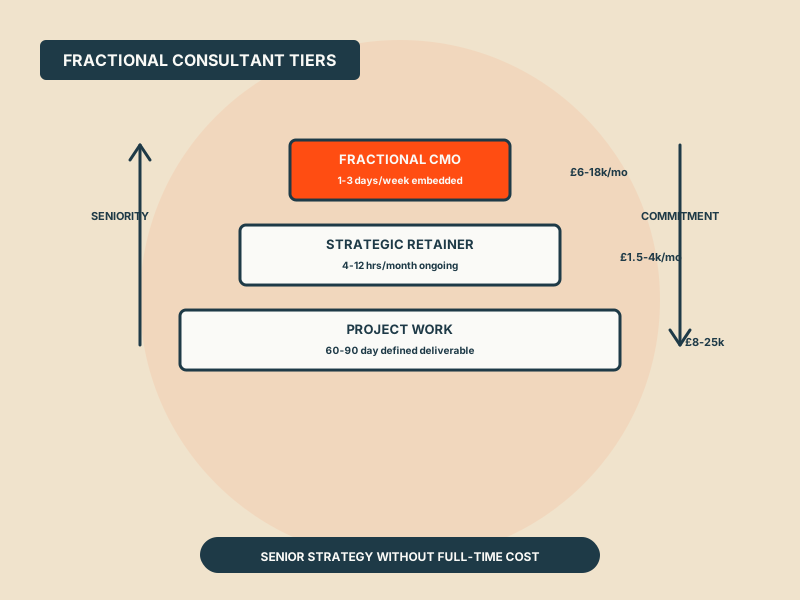
- Project-based (60-90 day engagements with defined deliverables): £8-25k total, depending on scope
- Retainer fractional (4-12 hours/month ongoing): £1.5-4k/month
- Embedded fractional CMO (1-3 days/week): £6-18k/month
- Specialist project work (attribution setup, channel testing, agency-evaluation): £5-15k per project
Below £1,500/month for ongoing engagement, you're not getting a senior person. Above £18k/month, you're better off hiring full-time.
How to test consultant quality before signing
Senior performance marketing consultants in 2026 should be able to:
1. Walk through 3 client scenarios with named outcomes. Specific clients, specific problems they solved, specific outcomes (with caveats and what went wrong, not just successes).
2. Articulate their philosophy on channel mix. Strong consultants have a view, when to over-index Meta, when to test TikTok, when paid search is enough, when affiliate matters. The view should be defensible and based on patterns from real accounts.
3. Have an opinion on attribution. As covered in our performance marketing agency post, attribution is the technical core of performance marketing. A consultant without attribution depth is operating above their depth.
4. Tell you when they're not the right fit. Senior consultants are calibrated. They'll tell you when your situation is wrong for them, too early, too small, wrong category, too execution-heavy. The willingness to say no is the strongest signal of seniority.
5. Have references that are not on their website. Active, contactable clients who'll talk frankly about working with them. Good consultants will offer 2-3 references unprompted.
The fractional CMO question
The senior end of performance marketing consulting overlaps with fractional CMO work. The lines blur.
Distinction worth knowing:
- Performance marketing consultant: focused specifically on paid acquisition + measurement. Doesn't usually own brand, content, lifecycle, or non-performance functions.
- Fractional CMO: owns the full marketing function fractionally. Brand, content, performance, lifecycle, sometimes product marketing. Performance is one of their portfolios but not the only one.
If you need just performance work, hire a performance marketing consultant. If you need full marketing leadership, hire a fractional CMO. Don't conflate them in pitch, the skill profiles are different and the wrong hire is expensive.
Where we sit
WMI doesn't operate at the strategic-consultant or fractional-CMO level. We're a paid-search execution + senior-strategy consultancy specifically, Google Ads, Microsoft Ads, and the tracking work that makes them measurable.
For accounts where paid search is the binding constraint, we sit naturally as the channel specialist within a broader performance-marketing programme run by your in-house team or a separate strategic consultant. We work well alongside fractional CMOs and performance marketing consultants, we're the depth on one channel, they're the breadth across all of them.
For a paid-search audit specifically, book a free audit. If you need cross-channel performance strategy, we'll point you to consultants we trust.
Get a free PPC audit from the team that wrote this.
We'll review your Google Ads or Microsoft Ads account and show you three specific things we'd change in the first 30 days.