
PPC management retainer, flat-fee vs percent-of-spend, and what each model rewards
PPC retainers come in two main shapes. They look similar on the invoice and behave differently in practice. The trade-offs that matter when picking which to sign.
PPC management retainers come in two main pricing shapes, flat fee per month, or percentage of media spend. They look similar on the invoice. They produce different incentives, different behaviour, and different long-term outcomes. The "right" model depends on your specific situation, and the wrong choice can cost you 10-15% of your annual ad budget over time.
If you're signing or renegotiating a PPC management retainer in 2026, here's what each model actually rewards on the agency side, and how to pick the one that aligns with what you want.
Model 1: Flat-fee retainer
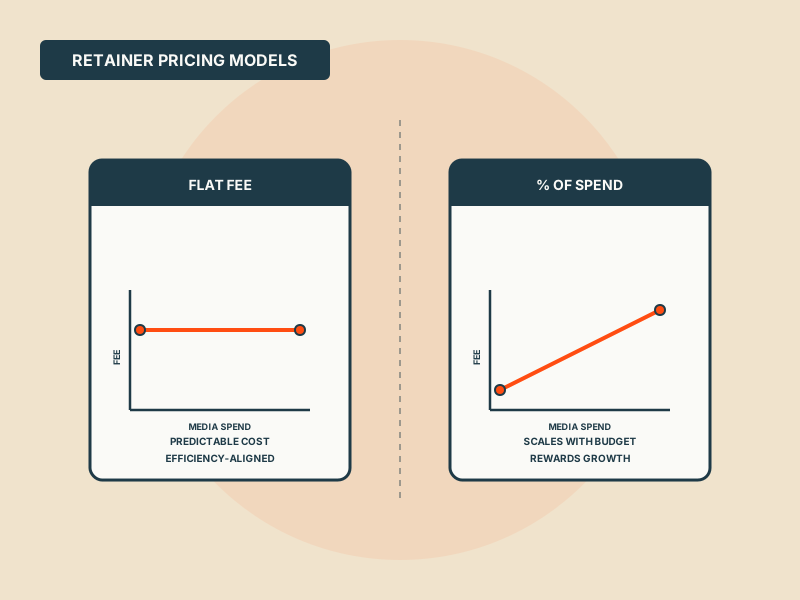
A fixed monthly fee, agreed upfront, doesn't scale with your spend. £2,000/month gets you the same service whether your account spends £8k or £30k.
Most senior consultancies and small agencies operate this way. Most large network agencies don't.
What it rewards on the agency side:
- Efficient delivery of agreed scope. The agency makes more profit by serving you well within their hour budget. They have no reason to push you to spend more.
- Long retention. Their predictable revenue per client is the lifeblood of the model. They want you happy and staying.
- Scope discipline. They'll resist scope creep because each additional task eats into their hour budget. Some buyers find this frustrating; it's actually the model working.
What it discourages:
- Aggressive growth recommendations. A flat-fee agency has zero financial incentive to recommend you spend more. If the right answer for your business is to scale spend 3x, they may not push it.
- Unbillable extra hours. A genuinely demanding client can quickly become unprofitable. The agency may quietly de-prioritise difficult accounts in favour of easier ones.
When flat-fee is right for you:
- You want predictable cost. Budget planning is easier.
- You don't want the agency's incentive to be "spend more". If your media budget is constrained or set by other factors, an aligned-incentive retainer is cleaner.
- You're at a stable spend level (not growing/scaling fast). A flat fee that fits your current spend will become stale if your spend triples in a year.
Model 2: Percentage-of-spend
The agency takes a percentage of your media budget, usually 10-20%. Your invoice scales linearly with what you spend.
Most network agencies and many mid-size agencies use this model. Most independent consultancies don't.
What it rewards:
- Scale. The agency makes more money when you spend more. Their economic interest is aligned with growing your account.
- Aggressive testing. They'll push to test new platforms, new campaign types, new audiences, partly because it's good practice, partly because larger budgets fund their fee.
- Scope flexibility. Because their fee scales, they can absorb extra work without a separate scope conversation.
What it discourages:
- Spend efficiency. This is the central tension. An agency on percent-of-spend has a structural disincentive to make your account run on less budget. *"We could probably get the same results on £8k that we're currently getting on £12k"* is a sentence that costs the agency 25% of its monthly fee on your account. Not all agencies act on this disincentive, but the structural pull is real.
- Honest underperformance discussion. If a campaign genuinely isn't working and should be cut, a percent-of-spend agency loses fee by recommending the cut. The honest call is harder to make.
- Long-term efficiency. Over 2-3 years, percent-of-spend accounts often drift toward higher spend at lower efficiency. Inertia + agency economics work the same way.
When percent-of-spend is right for you:
- You're scaling fast and want a partner whose interests grow with yours
- You have £20k+/month spend and want the agency to have skin in the game
- You're running aggressive growth phase where "test more, push harder" is genuinely the right strategy
- You're confident in your own ability to push back when the agency proposes spend that doesn't make sense
Hybrid models
A growing number of agencies offer hybrid pricing, flat retainer floor plus percent-of-spend above a threshold, or flat retainer plus performance bonuses tied to specific outcomes (CPA targets, ROAS, growth percentages).
Hybrids try to capture the upside of both models. They mostly work, but the contracts get complex and the misalignments live in the edge cases. The key questions for a hybrid:
- What's the floor? (Below what spend does the agency lose money on you?)
- What's the percent? (How much do they make if your spend doubles?)
- What are the bonus triggers? (What outcomes are they being rewarded for vs what costs them money?)
Run the math. A hybrid at £1,500/mo + 10% above £8k spend means at £15k spend you're paying £2,200/mo, versus a flat-fee competitor at £2,500/mo. Then at £25k spend you're paying £3,200/mo vs £2,500/mo flat. Find the cross-over point and decide whether your expected scale puts you the right side of it.
How to read agency pricing in pitches
Three patterns to watch:
1. Pricing that doesn't match the scope. If the agency is offering a £2,500/mo retainer for "complete PPC management including paid social and creative production", they're either underpricing (which means they'll struggle to deliver and quality will suffer) or the scope is hollow (they don't actually do most of what's listed). Real scope at real quality has real costs.
2. % of spend models with no floor. If the agency only quotes a percentage, ask what happens when spend drops. They should have a floor, say 10% of spend or £1,500/month, whichever is higher. Without it, your retainer is unstable.
3. Discounts for committing to longer terms. A 12-month minimum at 20% discount sounds attractive but locks you in. Senior agencies confident in their value give 30-day notice without discount; only ones worried about retention need long-term commitments.
The notice-period trick
Whatever the pricing model, the most important contractual term is notice period. 30 days is reasonable. 60 days is workable. 90 days+ is the agency protecting itself from your right to leave.
Push for 30 days. If they refuse, ask why. Their answer reveals whether they're confident in their work or worried you'll want to leave.
For more on what to test for in agency contracts, see our breakdown of choosing a Google Ads management agency.
Where we sit
WMI runs flat-fee retainers exclusively. We've used both models in earlier parts of our career and the flat-fee approach aligns better with what we want our incentives to look like, efficient delivery, honest about scaling decisions, no structural pull toward "spend more". The fee scales when your scope genuinely changes, not when your media budget moves.
If you'd like a flat-fee proposal for your account, book a free audit. The audit doubles as a scoping conversation, by the end you'll know what fee level fits your situation and what you'd be paying for.
Get a free PPC audit from the team that wrote this.
We'll review your Google Ads or Microsoft Ads account and show you three specific things we'd change in the first 30 days.