
Choosing a Google Ads management agency, the agency-model trade-offs nobody mentions in the pitch
Hiring an agency rather than a consultant or freelancer is a structural choice with consequences. The trade-offs that show up in month four, not month one.
Most "should we hire an agency or a consultant?" decisions get made on cost or capacity, not on the deeper structural trade-offs of the agency model. Those trade-offs don't surface in the pitch, they show up in month four, when the senior strategist who pitched you has rotated to a new account and you're working with someone you didn't interview.
If you're considering a Google Ads management agency rather than a consultant or in-house hire or freelancer, here's what's actually on the table, beyond the headline pricing and team size.
The economics that drive agency behaviour
A Google Ads management agency, like any agency, is a business. Its economic structure dictates what it does and doesn't optimise for, regardless of what the founders intend.
Utilisation matters more than results. Agencies bill by retainer or percentage-of-spend. Either way, account-team utilisation is the constraint they manage. An account that takes 20 hours a month to deliver "fine" results is more profitable than the same account taking 30 hours to deliver excellent results. There's a structural pull toward "good enough", not "great".
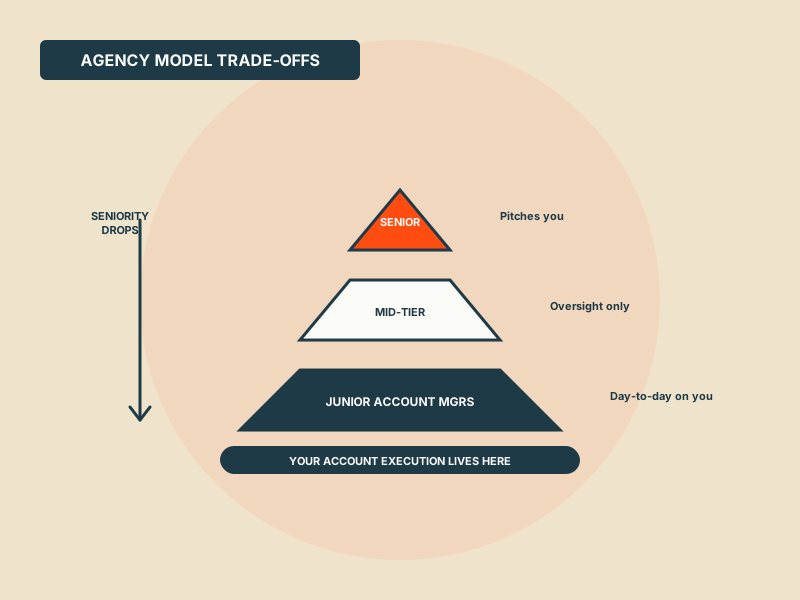
Junior-heavy delivery scales the team economics. Senior people pitch accounts and oversee them; junior people run them day-to-day. The day-to-day work on your account is going to be done by someone with less experience than the people who pitched. This isn't bad faith, it's how the cost structure works. The exceptions are senior-only consultancies (see archetype 4 in the London agency post) which deliberately price themselves out of this model.
Retention beats results, sometimes. A client retained on flat performance is more profitable than one retained on growing performance, because growth requires new strategic work. Some agencies (the good ones) reward themselves on growth; some (the average ones) reward themselves on retention. The metric structure inside the agency dictates which.
This isn't an indictment of agencies. It's an honest read of why agencies do what they do. The strong ones acknowledge the structural pulls and counter them deliberately. The weak ones just operate within them.
What to test for in the pitch
Five questions that surface the agency's actual operating model:
1. "Who specifically runs my account day-to-day, and how senior are they?"
You want a name and a tenure. *"Sarah, our senior strategist with 6 years of Google Ads experience"* is a good answer. *"One of our talented account managers"* is not. If they can't name the person, the answer means whoever's available.
Follow-up: *"Will the same person be running it in 6 months?"*, agencies have rotation patterns. A "yes" with a structural reason (e.g. *"we don't rotate accounts; clients keep their strategist for the duration"*) is meaningful. A "yes, of course" without explanation isn't.
2. "How do I get hold of the senior person if something goes wrong?"
You want a defined escalation path that doesn't go through the day-to-day account manager. *"Direct email and phone for me, anytime"*, from someone senior, is the answer. *"You'd raise it with your account manager who would escalate to me if needed"* is the polite agency answer that means slow escalation in practice.
3. "What does your monthly report look like, can I see one?"
A real agency will have a redacted monthly report ready to share in pitch. Read it. Look for narrative explaining what happened and why, not just data dumps. If the agency hasn't pre-prepared a sample, they probably don't have a consistent format, meaning what you'll get depends on which account manager produces it.
4. "What's the most recent account you lost, and why?"
Agencies that admit to losing accounts and articulate the reason cleanly are usually self-aware operators. *"We lost X in February. They wanted creative production we don't do, and we recommended [other agency]. Friendly parting."*, that's honest.
Agencies that claim they've never lost an account are either lying or new. Both are red flags.
5. "If we're not a fit for you, who would you recommend?"
Strong agencies have a referral network. They know which other agencies are good for which sub-segments. *"For e-commerce with under £5k/month, we'd send you to X. For B2B SaaS we'd suggest Y."*, that's an agency confident enough in its position to refer outside its wheelhouse.
Weak agencies will pretend to be a fit for whatever business you bring them. *"We can do that, sure"*, even when their portfolio is clearly not in your space.
The contractual structure to push for
Beyond the team and process questions, three contract terms matter more than most buyers realise:
Notice period. Default agency contracts often run 3-6 months notice. Push for 30 days. If they refuse, they're protecting themselves from your right to leave, which suggests they expect you to want to. A confident agency will accept 30-day notice because they trust their work.
Performance review milestone. Build in a 90-day review with a defined "what does success look like" metric agreed upfront. Ties the agency to the outcome you care about, not just retention.
Senior-time minimum. Specify how many hours per month of senior-strategist time are guaranteed on your account. *"Minimum 2 hours of [name] per month, with notes"* is a contractual hook that prevents the rotation-out problem. If they refuse this, they're telling you the senior person's time isn't really yours.
These three together protect you from the agency model's worst tendencies without preventing a healthy working relationship.
When an agency is genuinely the right choice
Despite the trade-offs, agencies are sometimes the right structural fit:
- You're spending £15k+/month on Google Ads and need consistent execution capacity that a single consultant can't sustain.
- You need integrated services, Google Ads + Meta + LinkedIn + creative production, and you'd rather have one accountable partner than five.
- You're scaling internationally and need teams in multiple markets, which only mid-size+ agencies can offer.
- You're a brand with formal procurement requirements that need a corporate counterparty rather than a sole trader.
In any of those, agency is the right shape. The trade-offs above just need to be managed deliberately rather than ignored.
When it isn't
The agency model is the wrong fit when:
- Account spend is under £8k/month. The economics don't justify the agency overhead, you'll be paying for capacity you don't need and getting junior-led delivery as a result.
- You need senior judgment more than execution capacity. A 2-3 person consultancy will give you better senior attention than a 50-person agency where the senior person manages 12 other accounts.
- The work needs custom thinking, not playbook application. Agencies scale by running similar processes across many clients. If your situation is genuinely unusual, an individual specialist will handle it better.
Where we sit
WMI is a senior-only consultancy, not an agency. We don't have juniors. The person who pitches you runs your account. Notice period is 30 days. Senior time is the only kind of time we have. If you need a 50-person team or 5-channel integration, we'll point you to an agency that does that well; we won't pretend to fit.
If you're trying to decide between us and an agency, book a free audit, the conversation will quickly clarify whether your situation needs senior judgment or execution capacity. Different problems need different shapes of partner.
Get a free PPC audit from the team that wrote this.
We'll review your Google Ads or Microsoft Ads account and show you three specific things we'd change in the first 30 days.