
Google Ads agencies in London, how to read the landscape and find the right one
London has more Google Ads agencies per square mile than anywhere else in the UK. Most pitches sound the same. A field guide to the actually-different patterns underneath.
There are more Google Ads agencies in central London than anywhere else in the UK. They all have nice websites. They all claim to be data-driven, transparent, and growth-focused. Most pitches sound the same.
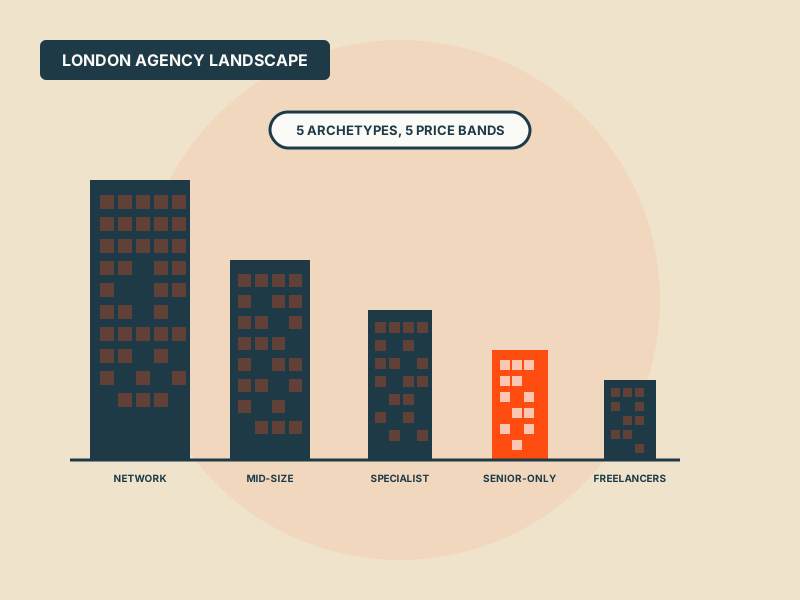
Underneath that surface, they're not all the same. There are five archetypes operating in the London Google Ads market in 2026, and the right fit for your business depends on which archetype matches the shape of your need. Here's the field guide.
Archetype 1: Network agencies
The big ones, usually part of WPP, Publicis, Omnicom, or Dentsu groups. London office is often a hub for European or global accounts. Hundreds to thousands of staff across the network.
Best fit for: Enterprise advertisers spending £50k+/month, multi-market campaigns, brands needing creative production tied to media buying, organisations that need formal procurement processes.
Failure mode: Account is set up by a senior strategist in the pitch, then handed to a junior team for day-to-day. By month four, the senior person is gone and you have an account manager 18 months out of university optimising your PPC.
How to tell: Ask "who specifically will be running my account in month six?" If the answer is anyone other than the people in the pitch room, that's the failure mode.
Archetype 2: Independent mid-size London agencies
20-150 staff, founded by ex-network-agency people, usually based in Shoreditch / Soho / Farringdon. Run a mix of accounts from £5k–£50k/month.
Best fit for: Mid-market businesses spending £10k–£40k/month who want senior attention without the network-agency overhead, accounts where Google Ads is one of 3–5 channels managed under one roof.
Failure mode: Capacity stress as they grow. The thing that makes them good, the founders or principals being involved, gets diluted as they hire to keep up with new business. By the time they're 80 staff, they often look more like Archetype 1 in everything but billing rates.
How to tell: Ask how their account-to-strategist ratio has changed in the last 18 months. If the answer is "we've grown the team in line with the client base", they're handling it. If it's "we've focused on retention so we haven't needed to hire", that's the early-warning that workload is on too few shoulders.
Archetype 3: Specialist boutiques
Small (3–15 staff), focused on a specific channel or vertical. Some are PPC-only; some are PPC + tracking + analytics; some are vertical specialists (e.g. finance, healthcare, B2B SaaS).
Best fit for: Businesses where the channel is the core growth lever (so depth in that channel is worth more than breadth across many), accounts with regulatory or category-specific complexity, businesses that already have other channels handled in-house or via other partners.
Failure mode: Bus factor. If their lead specialist leaves, the account quality often follows. Also, they can't easily expand scope, if you decide next year you want them to also run paid social, they'll either pretend (and underperform) or decline.
How to tell: Ask who'd cover for your strategist if they took two weeks off, and what their backup plan is if a key team member leaves. Specialists who can answer that crisply have built resilience; ones who can't are running on hope.
Archetype 4: Senior-only consultancies
Tiny (1–5 senior people), no juniors, retainer model. Founders or near-founders run every account. Selective on who they take on.
Best fit for: Accounts where strategic judgment is the binding constraint, businesses that already have the internal capacity to execute and just need senior thinking, situations where the cost of a junior making a wrong call is high (high CPCs, high deal values, complex tracking).
Failure mode: Limited capacity. They'll say no to engagements that don't fit. They aren't the right shape for businesses that need volume of execution (lots of creative variations, daily fast-turnaround tasks, multi-market simultaneous launches).
How to tell: They tell you upfront they don't take on more than X clients, they have a defined "no" list, and they have a wait-list pattern.
Archetype 5: Freelancer collectives
Two or three Google Ads freelancers operating under a shared brand for marketing purposes, but functionally independent. Usually no office, distributed working, low overheads.
Best fit for: Smaller accounts (£3k–£10k/month) where agency overheads aren't justified by the scale, businesses that don't need formal SLAs or procurement-friendly contracting, comfortable with informal communication.
Failure mode: Inconsistency. The level of service depends entirely on which freelancer ends up handling your account. They look like an agency from the outside but operate like loosely-connected individuals.
How to tell: Ask whether the same person will handle your account every time, or whether tickets get routed. Ask to see their company registration and how long the entity has existed. Anything under 2 years suggests recent rebrand or restructure.
How to read the room in a pitch
Beyond the archetype, three things to watch in a pitch meeting:
Who's in the room. If three senior people pitch, and only one is named on your account in the proposal, the other two were "show ponies" for the pitch and won't be involved.
Specificity of the questions. A good agency will ask uncomfortable questions in the first 30 minutes, about your CRM, your closed-deal data, your conversion tracking, your sales process. A weak pitch is the agency talking at you with their methodology.
Whether they push back. Strong agencies will disagree with something you've said in the briefing. Weak ones will agree with everything to keep the relationship moving.
Pricing patterns that tell you something
In central London, 2026:
- Network agencies: £8k+/month minimum. Often percentage-of-spend at 10–15%.
- Mid-size independents: £3k–£12k/month retainers, sometimes hybrid retainer-plus-spend.
- Specialist boutiques: £2.5k–£8k/month, mostly flat retainers.
- Senior-only consultancies: £1.5k–£6k/month, flat retainers, fewer clients.
- Freelancer collectives: £1k–£3k/month, hourly or flat.
If pricing is below the range for the archetype, ask why. Sometimes it's promotional pricing. Sometimes it's a sign of overcapacity (they're hungry for new business). Sometimes it's an inexperienced operator who hasn't priced themselves correctly yet.
Where we sit
WMI is a senior-only consultancy (Archetype 4), small team, retainer model, no juniors, named principals on every account. Strong fit for £3k–£30k/month accounts where senior judgment matters. Wrong fit if you need a 30-person creative team, multi-market simultaneous launches, or scope across 5+ channels.
If you want a pitch from us, book a free audit. We'll tell you within the first 30 minutes whether we're the right archetype for your situation. If not, we usually have specific suggestions for which kind of agency would be.
Get a free PPC audit from the team that wrote this.
We'll review your Google Ads or Microsoft Ads account and show you three specific things we'd change in the first 30 days.