
Google Ads expert, what the title actually means in 2026 and how to spot a real one
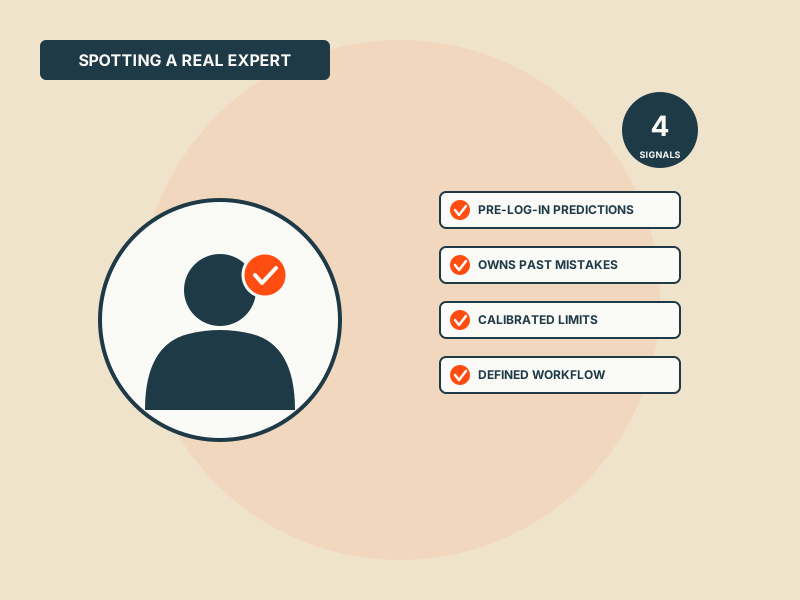
"Google Ads expert" went from a meaningful credential to a self-issued LinkedIn title. Here's what the term should mean today, and the four signals that separate genuine expertise from claimed expertise.
"Google Ads expert" used to mean something specific: someone who'd run accounts long enough to have seen multiple algorithm shifts, multiple bid-strategy generations, and enough categories to spot patterns. By 2026 the term has been diluted into a self-issued LinkedIn label. Anyone can write it on their profile.
That doesn't mean experts don't exist, they do, and they're more valuable than ever as the platform has gotten more complex. It just means the title isn't proof. You need to test for the underlying capability, not the label.
This post is about what "Google Ads expert" should actually mean today, what the genuine markers of expertise look like, and the four signals that separate the real ones from the rest.
What "expert" should mean today
Before testing for it, define it. A genuine Google Ads expert in 2026 has four things:
1. Pattern recognition across accounts. Has seen enough accounts to know what's going on without having to read all the docs again. When they see a Performance Max campaign behaving oddly, they have three or four hypotheses ready, in priority order, before opening a single report.
2. Mental models for the platform's evolution. Knows what's changed in Google Ads in the last 18 months and what's likely to change in the next 18. Doesn't blindly follow Google's recommendations because they understand which recommendations move advertiser numbers vs Google's revenue.
3. Diagnostic thinking, not playbook application. Approaches every account as a unique system. Asks questions before recommending. The opposite of the playbook-applier who tells every account it needs the same three things in the first month.
4. Honest about limits. Knows the categories they're strong in and the categories they aren't. Won't pretend to be an expert in B2B SaaS if their experience is e-commerce. Will recommend you find someone else if you're outside their wheelhouse.
A claimed expert without any one of these isn't, regardless of LinkedIn title or certification.
Four signals that separate real from claimed expertise
Signal 1: They make falsifiable predictions before seeing your account.
Ask a real expert "what do you think is wrong with our account?" before they've logged in. They'll have specific guesses, attached to category-typical patterns. *"In B2B SaaS at this spend level, the most common issue I'd expect is offline conversion data not being passed back. Search-terms cleanup is usually second. The third thing depends on your bid strategy choice."* They're putting predictions on record before they have data.
A claimed expert will deflect: *"I'd need to look at the account first."* That answer protects them from being wrong but tells you nothing about their thinking. Real experts get more specific the deeper you push, not vaguer.
Signal 2: They reference their own past mistakes.
Real experts have war stories that include things they got wrong. The campaign they killed too early. The bid strategy they kept too long. The new client they shouldn't have taken. The mistake they made in 2022 that taught them what they know in 2026.
Claimed experts have only success stories. Their war stories are about clients who were difficult, attribution that was unfair, or seasonality that was unfavourable. Never about their own judgment failing.
If you can't get a real "I got this wrong" story out of someone in 30 minutes, they either haven't been operating long enough to have one, or they're not honest about their work.
Signal 3: They're calibrated on what Google Ads can and can't do.
Real experts will tell you when Google Ads isn't going to work for your business, and they'll be specific. *"Your category has limited search intent at scale. You'll get some, but you'll be capped at 30-40 leads a month at any reasonable CPA. To grow past that you'd need a different channel."*
Claimed experts pitch Google Ads as a fit for everything. Every business needs more Google Ads spend. Every problem is solvable with better bidding strategy, more keywords, or another campaign type. The tool fits every job.
This isn't a sales personality difference. It's a calibration difference. Real experts know the boundaries of what their tool can do because they've hit those boundaries before. Claimed experts haven't.
Signal 4: They have a defined workflow for inheriting accounts.
Real experts have a sequence they follow when they take over an account. It's been refined over years. They can describe it in 5-10 minutes without notes. *"Day 1: conversion tracking audit. Day 2: search terms across 90 days, sorted by spend. Day 3: account structure walkthrough. Day 4-5: bid strategy review against volume. Days 6-7: report writing and a 'first 30 days' plan."*
Claimed experts will tell you they "audit the account thoroughly" without describing what that involves. The vagueness is the tell.
The certification question
Where do platform certifications fit? They're a decent floor, knowing the certifications haven't been failed tells you the person can do the basics. But they don't certify expertise.
The Google Ads Search certification can be passed in an afternoon. The Google Premier Partner programme certifies an organisation, not the individual you'll work with. Microsoft Advertising's certifications are similar. A consultant with all five Google certifications and one year of accounts under their belt is less expert than someone uncertified with eight years of varied accounts.
Treat certifications as table-stakes, not as proof. Test for the underlying capability.
Where Google Ads experts cluster
Real experts in 2026 tend to cluster in three places, in roughly equal numbers:
Senior-only consultancies (small teams, see consultant vs agency vs in-house), these are usually founders or near-founders who've left larger agencies. The experts didn't want to spend their time managing junior team members; they wanted to keep running accounts.
Senior in-house at large advertisers, usually CMOs or Heads of Performance at brands spending £500k+/month. The accounts are big enough to justify hiring an expert internally rather than relying on an agency.
Independent freelancers, see Google Ads freelancer red flags for how to filter, but the genuine end of the freelance market is where you'll find some of the strongest individual operators. They've often left agency life to work with a small handful of clients deeply rather than across many superficially.
You're less likely to find a true expert as the day-to-day account manager at a mid-size or network agency, because the economics of that role push the senior person out into pitching, oversight or strategy work, not hands-on management.
A test you can run on any expert claim
Show them an Auction Insights report from your account (or any account, even one of theirs they're willing to share) and ask: "Walk me through what this is telling us."
A real expert will spend 5-10 minutes on it, surfacing patterns about the auction landscape, competitor strategy, and what the data implies about your bidding posture. The interpretation will be layered.
A claimed expert will read the columns out loud and say "looks competitive, you'd want to bid higher to gain impression share." That's reading data, not interpreting it.
What to do with this
If you're hiring a Google Ads expert, the four signals above are your filter. Run an unstructured conversation with whoever you're considering. Listen for: falsifiable predictions before seeing the account, mention of past mistakes, calibration on what won't work, and a structured inherit-account workflow.
If three of the four are present, you're talking to someone real. If all four are present, you're talking to someone in the top 10%. If one or none, keep looking.
For a structured version of this test, book a free Google Ads audit, by the end of the call you'll have a clear sense of how we'd answer those signals, and either way you'll have a sharper test to apply to the next consultant or agency you talk to.
Get a free PPC audit from the team that wrote this.
We'll review your Google Ads or Microsoft Ads account and show you three specific things we'd change in the first 30 days.