
Meta Advantage+ Shopping: the diagnostic problem nobody warns you about
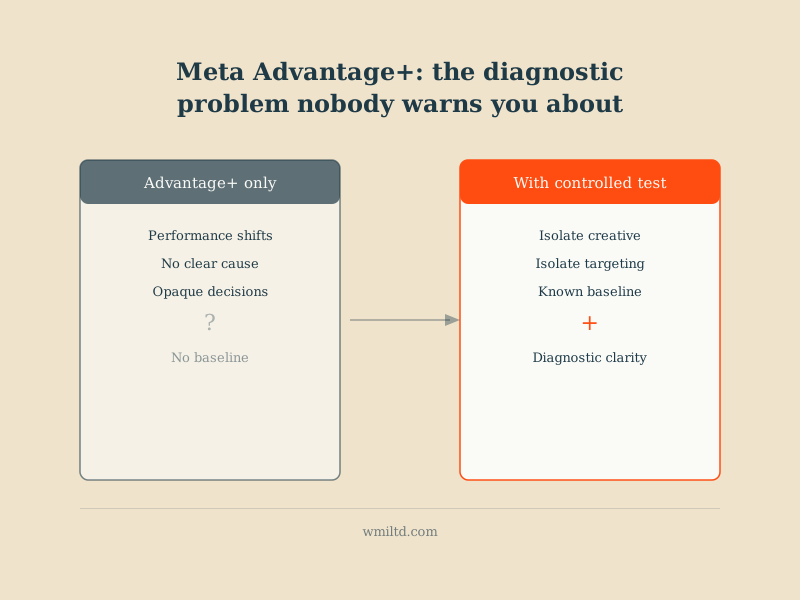
Advantage+ Shopping works. The failure mode is not the algorithm making bad decisions. It is that when performance shifts, you have no diagnostic layer left to explain why. Here is how to use Advantage+ without losing the ability to investigate when something goes wrong.
Meta's Advantage+ Shopping campaigns are a genuinely effective product. The algorithm handles targeting, placement, bid, and a significant portion of the creative decision-making. For accounts that have set them up correctly, the results are frequently better than a manually managed structure on the same budget. The product does what it says.
But there is a specific failure mode that is becoming common, and it is not the one most people warn about. The failure is not that the algorithm makes bad decisions. The failure is that when performance shifts, there is no diagnostic layer left to explain why.
How the failure mode develops
The pattern is consistent across the accounts where Advantage+ underperforms. The brand had a working manual structure: controlled campaigns with defined audiences, placement exclusions, and creative sets that had been tested and filtered over time. Advantage+ offered a simpler path. Less management overhead, fewer levers to adjust weekly, a single campaign type that could replace several. The switch was made.
The first few months usually look reasonable. Advantage+ finds efficiencies the manual structure was missing. Cost per result stabilises. Delivery broadens. The account manager spends less time on weekly adjustments.
Then something shifts. Cost per result doubles over three weeks. The account manager pulls the Advantage+ reporting: creative performance breakdown, audience split estimate, placement breakdown. None of it points clearly to a cause. The algorithm does not explain its decisions in the way a manually controlled structure does. You can see the outcome. You cannot see the input that changed.
With a manual structure, this kind of shift is diagnosable. You can isolate whether it was creative (swap the underperforming asset, watch what happens to CPA), targeting (turn off the broad audience, see if the lookalike still holds), or placement (exclude the placements that inflated reach without adding conversions). When the levers are yours, you can pull them one at a time and observe the effect.
With Advantage+ as the sole structure, the levers are inside the algorithm. You can change the creative. You can change the budget. If neither change fixes the problem, you are waiting for the algorithm to find a new equilibrium on its own. That waiting period is expensive, and it is indefinite because you have no way to know when it has concluded.
What diagnostic capability actually looks like in practice
A useful framing: the manual structure is not a fallback for when Advantage+ fails. It is a measurement instrument that lets you interpret what Advantage+ is doing.
When you run a controlled campaign alongside Advantage+, with defined audiences and fixed creative, you can observe the performance difference between the two simultaneously. If the controlled campaign holds steady and Advantage+ degrades, the problem is in the algorithm's decisions: most likely targeting or bid strategy drift. If both degrade together, the problem is upstream. The creative is fatiguing, the offer is getting stale, or the market has shifted in a way that affects both structures equally.
Without the controlled structure, you cannot make that distinction. You have one data point from a system that makes opaque decisions. Good creative performance metrics help, but they measure engagement inside the algorithm's audience, not against a known baseline. The absence of the baseline means every diagnostic conversation starts with a guess.
This is the argument for keeping some form of manual structure alongside Advantage+ even after the algorithm has proved itself. It is not about distrust of Meta's model. It is about maintaining the reference point that makes your own interpretation possible. See Performance Max vs Search: when to use which for the same principle applied to Google's equivalent product, where the trade-off between platform efficiency and diagnostic visibility follows the same pattern.
The brands that started without a baseline
There is a second category of problem, less common but more expensive to fix. Brands that were newer to paid social, or that had allowed their Meta accounts to lapse before restarting them, launched directly into Advantage+ without first establishing what a controlled structure would produce.
These brands have a specific problem: they do not know what normal looks like. When Advantage+ performs well, they cannot confirm it is outperforming the alternative because there is no alternative to compare against. When it underperforms, they cannot tell whether the problem is the account structure, the market, or the creative. Every decision becomes a guess because there is no controlled reference point.
The fix, in retrospect, is to have run a structured campaign first: tested the core creative variations, established the audience buckets that convert, confirmed the conversion tracking is accurate on the events that actually matter, and then introduced Advantage+. That sequence takes a few months. Brands that skip it give a sophisticated algorithm a data-free environment and hope the model fills in the gaps. Sometimes it does. When it does not, they have no diagnostic path because they never built the baseline.
The deeper issue: efficiency and understanding are not the same thing
The operational case for Advantage+ is real. It reduces management overhead. It consolidates creative testing. It frees up time that would previously have been spent on manual bid adjustments and audience exclusions. For most accounts, it will deliver acceptable performance with less active management than a full manual structure requires.
But efficiency and understanding are not the same thing. Advantage+ can be highly efficient at spending your budget in ways you cannot fully explain. If the business is growing, this is acceptable. If growth slows or efficiency degrades, the inability to explain what the algorithm is doing is not a management advantage. It is a liability, because every intervention you consider has to be based on incomplete information about what the system is actually responding to.
See AI does not replace media buyers, it moves the work up the stack for the broader framing here. The principle is the same across platforms: systems that automate execution efficiently do not remove the need for diagnostic judgment. They shift the work that requires judgment from execution to interpretation.
The accounts that use Advantage+ best treat it as an execution layer. The strategy, what the creative says, who the brand is for, what a conversion actually means to the business, stays with the operator. The algorithm handles the delivery. That division of responsibility is explicit and maintained even when the algorithm is performing well.
What to actually do
If you are running or planning to run Advantage+ Shopping, here is the practical approach:
- Establish baselines before switching. Run a structured manual campaign for at least six to eight weeks. Test your core creative angles, confirm which audience types convert, and verify that conversion tracking is firing correctly on the events that matter. Introduce Advantage+ only once you have a benchmark to measure against.
- Keep a controlled campaign running alongside Advantage+. It does not need a large share of the budget. Ten to twenty percent of the Advantage+ budget is enough. It needs fixed audiences, fixed creative, and defined placements. Its purpose is measurement, not delivery volume.
- Review Advantage+ performance against the controlled campaign weekly. When the two diverge, investigate before adjusting anything. The divergence itself is information. It tells you whether the problem is in the algorithm's decisions or in something that affects both structures equally.
- Define what working looks like at a business level before optimising for it at a platform level. If you tell Advantage+ to optimise for purchases, confirm those purchases are the ones that matter for gross margin and customer lifetime value. If the algorithm is optimising for small-basket, high-frequency orders when the business model needs high-basket, considered orders, platform efficiency is not the same as business efficiency.
- Document the creative that was working in your manual structure before switching. The copy angles, the offer framing, the visual styles that drove results. Advantage+ will iterate away from your starting creative over time. When it does, knowing what worked historically gives you a direction to test toward rather than restarting the creative process from nothing.
- Build a diagnostic response plan before you need one. If Advantage+ cost per result doubles, what will you check first? Who is responsible for the investigation? What is the threshold for pausing and rebuilding the structure manually? Most accounts do not have this plan. Writing it when everything is working means you have a procedure rather than a panic when something breaks.
The question before handing over control
Meta's pitch for Advantage+ is compelling precisely because it is often true: the algorithm finds efficiencies a manual structure misses. But performing well and remaining manageable when it stops performing well are different things. The diagnostic question worth asking before giving the algorithm full autonomy is simple: what is your plan when it stops working?
If the answer is "I will look at the creative breakdown and the audience split", you have a shallow plan. If the answer involves a parallel controlled campaign with a known baseline, a creative asset library tested under manual conditions, and a clear escalation procedure, the algorithm is working for you rather than instead of you. The goal is not to distrust Meta's model. The goal is to make sure your operation is interpretable when the model changes its behaviour, as all models eventually do.
If you want a review of your current Meta structure and whether you have the diagnostic capability to manage performance shifts properly, book a free audit. We will look at what baselines you have, what your controlled comparison is, and what your visibility looks like if Advantage+ performance degrades.
Get a free PPC audit from the team that wrote this.
We'll review your Google Ads or Microsoft Ads account and show you three specific things we'd change in the first 30 days.