
AI does not replace media buyers, it moves the work up the stack
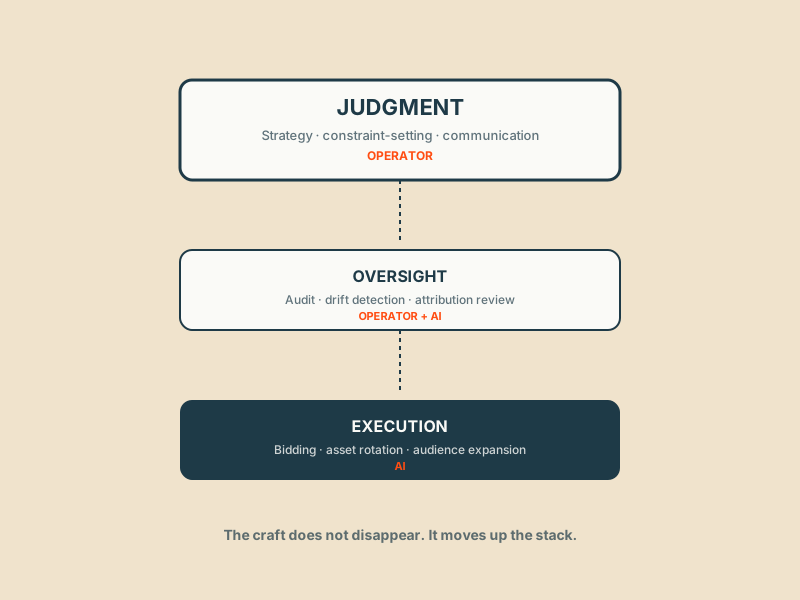
The 'AI replaces the media buyer' narrative assumes the buyer's job is to do things. It is not. The job is to know what to do, when, and why, to catch the signal the platform missed, decide the bid floor doesn't make sense this week, tell the client the channel mix needs changing before the report confirms it. AI handles volume. The operator handles judgment. Operators who treat AI as a threat will lose. Operators who treat it as a substitute for their own judgment will lose faster.
The "AI replaces the media buyer" narrative has been circulating for two years now. It is louder this quarter because Google Ads, Microsoft Ads, and Meta have all shipped material new automation features. The conclusion in most LinkedIn posts is the same: media buyers are about to be obsolete, agencies are about to be hollowed out, the work is becoming a commodity.
The narrative assumes the media buyer's job is to do things. It is not. The job is to know what to do, when, and why. To catch the signal the platform missed. To decide the bid floor does not make sense this week. To tell the client the channel mix needs changing before the report confirms it.
AI handles volume. The operator handles judgment.
These are not the same thing. The people most confident that one replaces the other have not been in the room when an account breaks mid-month and someone has to decide what to do in the next two hours.
What AI is actually good at
It is worth being specific. AI is already very competent at:
- Bid optimisation against a defined objective. Given a clear conversion definition and enough volume, Smart Bidding outperforms manual bidding in most accounts. This has been true since 2022.
- Asset rotation and creative variation. Responsive Search Ads, Performance Max asset groups, Audience Network creative rotation. The platforms test variants faster than any human team can.
- Audience expansion. Lookalike-style expansion, in-market segment generation, signal-based prospecting. The models find audiences a human would not have thought to test.
- Anomaly detection in raw numbers. When a metric moves outside its normal range, automated alerts catch it within hours, not days.
Each of these is genuinely useful. Pretending the automation is bad is a way to lose to operators who use it well.
What AI is bad at
It is also worth being specific about the other side. AI is bad at:
- Deciding the conversion definition is wrong. Smart Bidding optimises against whatever you tell it to optimise against. If "form submission" is the conversion and 30% of submissions are spam, the system happily bids harder for spam. A human has to notice and re-define. See Google Ads low conversion rate: a systematic fix list for the longer version.
- Recognising a strategic shift in the business. When the company pivots product, repositions, or shifts ICP, the historical conversion data the model is learning from becomes a misleading guide to what to optimise for next. A human has to catch the discontinuity and reset the system's reference frame.
- Catching attribution problems before they corrupt bidding. When conversion tracking breaks subtly, a deduplication issue, a script change on a landing page, a CRM sync that started double-counting, the model trusts the broken signal. By the time the dashboards visibly drift, the bidding has already over-optimised against bad data.
- Holding the line on a budget or principle. "We do not bid on competitor brand terms" is a strategic choice. The model will quietly suggest it would improve performance if you did. Someone has to decide.
- Communicating to the client. "Here is what changed, why, and what we are doing next" requires the operator to have understood it themselves first. The automation does not summarise itself in a way a non-technical buyer can act on.
These are not edge cases. They are the everyday work of running an account that performs not just well on the dashboard but well in the business. The operator catches them; the automation does not.
Where the work is moving
The honest framing is that the work is not disappearing. It is moving up the stack.
- Less time on tactical optimisation. The automation does most of the bid adjustments, ad copy testing, and audience expansion that used to be a junior's job. Five years ago a media buyer might spend 30% of the week on these. Now it is 5-10%.
- More time on strategic decisions. Which campaign types to run, what counts as a conversion, what to do when the business shifts, how to interpret the automation's output. This used to be a small minority of the work; it is now most of it.
- More time on measurement infrastructure. Building conversion tracking properly. Wiring up Enhanced Conversions, offline conversion import, server-side tagging, CRM integration. Most of the value-add an experienced operator brings in 2026 is upstream of the campaigns, it is making sure the platform is being fed the right signal in the first place.
- More time on client communication. Explaining what the automation is doing, why it chose what it chose, what the operator overrode and why, what to expect next quarter. The "consulting" half of "PPC consulting" is becoming the majority of the role.
This is why the agencies losing share to "AI-powered" software platforms are not the senior, judgment-led ones. They are the ones whose value proposition was doing volumes of tactical work that the platforms now do for free. The work has moved; the role description has not caught up; the layoffs follow.
What to actually look for in a media buyer in 2026
If you are hiring, or evaluating an agency, the signals worth paying attention to:
- Can they articulate what their conversion definition optimises for, and what business outcomes that maps to? If they cannot, the model is in charge.
- Can they describe a recent decision they made against the automation's recommendation? "We turned off the AI's suggestion to expand budget here because of X" is the answer of someone running an account. "We let the system optimise" is the answer of someone watching it.
- Do they review the search-terms report weekly even on AI Max campaigns? Aggregate reporting hides the same waste it always did.
- Have they touched conversion tracking in the last 90 days? Enhanced Conversions, offline conversion, attribution model changes. If not, the data layer is rotting underneath the automation.
- Can they explain what they would do if the automation broke for 48 hours? The operators who can answer this are the ones whose work survives the automation.
The deeper version of this evaluation lives in 9 questions for hiring a UK Google Ads expert and the role-level framing in Google Ads consultant vs agency vs in-house.
The takeaway
Operators who treat AI as a threat are going to lose, they will keep doing volumes of tactical work that the platforms now do for free, while clients pay less and less for it.
Operators who treat AI as a substitute for their own judgment are going to lose faster, they will let the model optimise toward whatever signal is loudest, miss the strategic shifts, and surface the consequences three months later when the business asks why the numbers look strange.
The operators who win are the ones who treat AI as a powerful but narrow tool. They use it for the parts of the work it is genuinely good at, build audit infrastructure around the parts it is bad at, and spend the time it frees up on the strategic decisions that automation cannot make. The craft does not disappear. It moves up the stack.
If you want to talk through whether your current PPC setup is treating the automation as a tool or being treated by it, book a free audit. We will look at where the decisions in your account are being made, who is making them, and what the gap is between what your dashboards show and what your business actually sees.
Get a free PPC audit from the team that wrote this.
We'll review your Google Ads or Microsoft Ads account and show you three specific things we'd change in the first 30 days.