
Paid ads management in the UK, what "paid ads" includes beyond PPC, and what changes for UK accounts
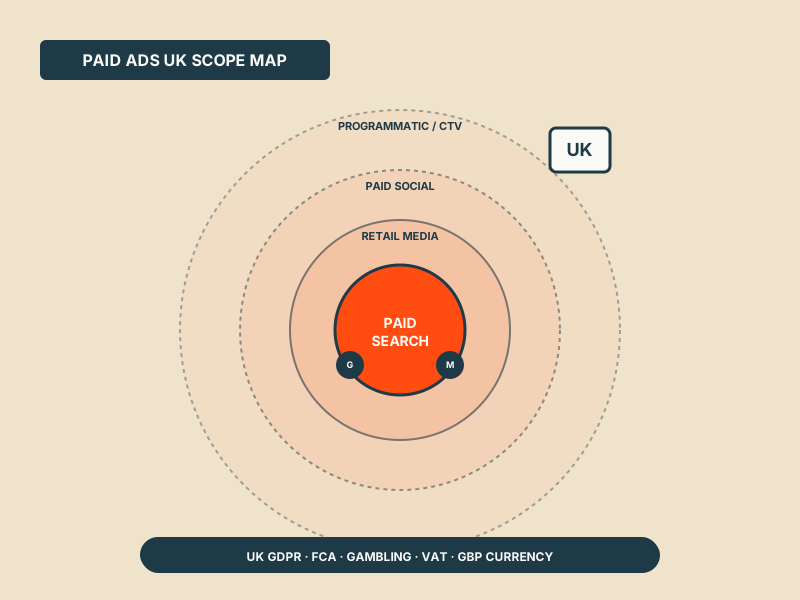
"Paid ads management" is broader than PPC, it covers paid search plus paid social plus display. The UK adds country-specific compliance and economic context. A scope-and-context map.
"Paid ads management" is a broader term than "PPC management". It covers everything you pay to run on advertising platforms, paid search, paid social, programmatic display, retail media, and increasingly connected-TV. If you're hiring or evaluating someone for "paid ads management" in the UK, the scope question is more open than for "PPC management" specifically.
This post lays out what "paid ads" usually includes, what each part does, and what specifically changes for UK-based businesses managing the full paid-ads stack.
What "paid ads" usually includes in 2026
Paid search, Google Ads, Microsoft Ads. Bid on keywords or use automation to put ads in front of high-intent searchers. Covered in detail in our PPC agency post.
Paid social, Meta (Facebook + Instagram), LinkedIn, TikTok, X, Pinterest, Snapchat. Bid on audience segments and interest signals to put ads in front of users in social-platform feeds and stories. Conversion-rate is generally lower than search but reach is higher and creative is more important.
Programmatic display, banner ads bought through programmatic networks (Google Display Network, The Trade Desk, DV360) targeting users across the open web. Mostly used for brand awareness and remarketing.
Retail media, Amazon Ads, increasingly Tesco Media, Boots Media, Sainsbury's, etc. Place product ads on retailer-owned platforms, hugely growing channel for product brands.
Connected TV / video, YouTube as a video channel, plus emerging CTV platforms (Roku, Sky AdSmart). Video-first formats, audience-targeted, high-cost but increasingly measurable.
A "paid ads agency" that genuinely covers all of this is very rare, most agencies cover 2-4 of these channels at depth. The right scope for your business depends on where your customers actually are.
What changes for UK paid ads specifically
Six things are meaningfully different about running paid ads in the UK vs other markets:
1. UK GDPR and ICO consent rules.
The UK runs its own version of GDPR (post-Brexit), enforced by the ICO. The headline rules are similar to EU GDPR but the enforcement style and recent guidance differ. For paid ads specifically:
- Consent Mode v2 is required for any account using smart bidding, Customer Match, or remarketing audiences in the UK
- Cookie consent banners need granular ad-storage consent (not the legacy "by using this site, you accept cookies")
- Customer Match list uploads need a documented lawful basis, historic email lists may not qualify if the original opt-in didn't anticipate ad targeting
- LinkedIn Profile Targeting on Microsoft (UK B2B) has its own consent considerations
This isn't unique to paid ads, it applies to all UK marketing. But paid ads sits at the front line where most of these rules become operational.
2. Currency and tax handling.
Paid ads platforms invoice in different currencies. Google Ads and Meta default to GBP for UK accounts, but TikTok, Pinterest, and some retail-media platforms invoice in USD or EUR. Reconciling actual cost-per-result across multi-currency invoices needs a deliberate process, most agencies don't do it well.
VAT also varies: Google and Meta charge UK VAT on UK accounts, but reverse-charge applies for some B2B accounts using their VAT number. Worth getting straight in onboarding.
3. UK auction economics across channels.
Different channels have different UK premiums vs other markets:
- Google Ads: London CPCs ~30-50% above UK regional, see our London-management post
- Microsoft Ads: Lower than US/EU baseline, less competitive UK auction. Strong arbitrage opportunity for B2B accounts
- Meta: Comparable to other developed markets, not particularly UK-distorted
- LinkedIn: Higher UK CPCs than US for B2B targeting, especially for senior roles
- TikTok: Lower CPM than US/EU, growing market, less competitive
A UK paid-ads strategy should consciously play against these auction economics, overweight the cheaper auctions where audience overlap permits, and be pricing-conscious in expensive ones.
4. UK regulatory categories.
Several UK industries have advertising restrictions on paid-ads platforms that don't fully match other markets:
- Financial services, FCA-authorised approval required for credit, investments, insurance ads on Google, Meta, X, etc.
- Gambling, Gambling Commission licence; specific creative restrictions; pre-watershed rules apply differently
- Cryptocurrency / financial trading, restrictive on Google and Meta in the UK; full FCA registration required for promotion
- Healthcare and pharmacy, prescription drugs cannot be advertised to consumers; OTC and pharmacy products have specific creative requirements
- Alcohol, different formats allowed at different times, specific platform rules
UK paid-ads management for any of these sectors needs deliberate compliance handling at campaign-setup time, not retroactive fixes.
5. UK creative and tone considerations.
UK consumer advertising tends to be more understated and humour-tolerant than US equivalents. American-style aggressive direct-response copy often underperforms in UK markets, particularly for considered-purchase B2C and most B2B. A US paid-ads playbook applied to a UK account may show solid metrics on platform but struggle to drive real business outcomes because the creative is wrong tone.
6. UK measurement and attribution.
Cookie restrictions in iOS / browser-level tracking limits hit UK measurement infrastructure roughly the same as other developed markets. But UK-specific CRM integrations matter:
- HubSpot is more popular in UK B2B than equivalent positions of HubSpot in some other markets, paid-ads attribution often runs through HubSpot
- Salesforce is dominant in UK enterprise, with specific Marketing Cloud / Pardot integrations
- GoHighLevel is increasingly popular in UK SMB / agency sectors
The integration choice affects what offline-conversion data can flow back to ad platforms, which affects bid quality. UK-experienced paid-ads managers know which integrations work cleanly.
How to scope a paid-ads management engagement
Most businesses don't need all five channels at depth. The scoping conversation should answer:
Where are your customers? If your customers are heavy LinkedIn users (B2B), LinkedIn-first paid-social. If they're TikTok-native (younger consumer), TikTok before Meta. If they shop on Amazon (product brands), Amazon Ads as a primary channel.
What's your conversion event? High-intent purchases (e-commerce) play to search-first strategies. Discovery/awareness moments (lifestyle brands) play to social-first.
What's your creative bandwidth? Paid social needs constant creative production. If you don't have that bandwidth in-house or via your agency, scoping social-heavy paid ads will struggle.
What's your budget threshold? Below £10k/month total paid budget, picking 1-2 channels is right. £10-50k/month, 2-3 channels with one primary. Above £50k, multi-channel makes sense.
The scope conversation should produce a primary, secondary, and "test/explore" channel allocation. An agency that proposes "we'll run all five from day one" hasn't done the scoping work.
Where we sit
WMI is a paid-search consultancy, Google Ads and Microsoft Ads, with associated tracking and attribution work. We don't run paid social, programmatic, or retail media. The reason: search-intent advertising is its own discipline, and trying to be excellent at all five channels means being average at all of them.
For paid-search-heavy accounts (typically B2B SaaS, considered-purchase B2C, professional services), we're a strong fit. For accounts where paid social or paid commerce drives more revenue than paid search, we'd refer you to specialists who focus there.
Book a free audit for a UK-specific paid-search review. We'll also flag if your channel mix suggests you'd be better served by a different agency type.
Get a free PPC audit from the team that wrote this.
We'll review your Google Ads or Microsoft Ads account and show you three specific things we'd change in the first 30 days.