
"Top PPC agencies" rankings, how the lists actually work and why most are pay-to-play
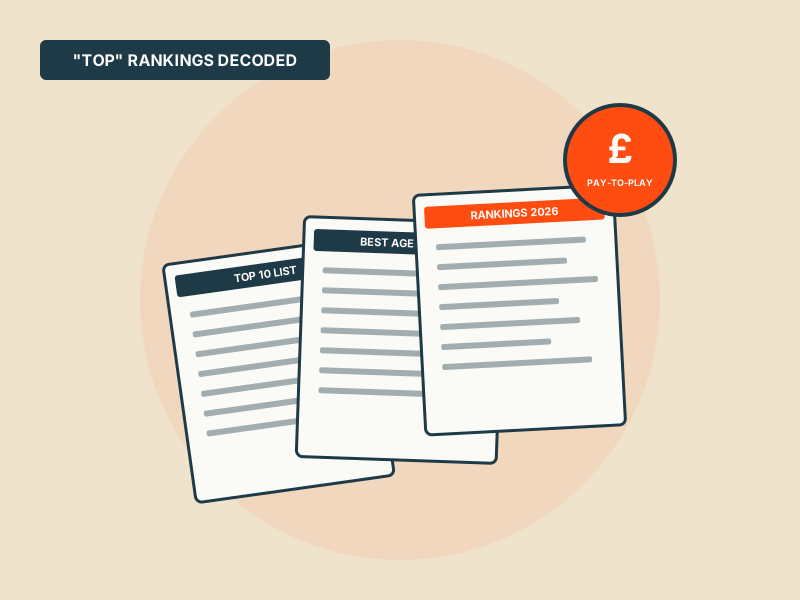
Search "top PPC agencies UK" and you'll find list articles ranking the same agencies in different orders. A look at how those rankings get made and why they don't reliably tell you who's actually good.
Search "top PPC agencies UK 2026" and you'll find dozens of list articles. Most rank the same 15-20 agencies in different orders, on different sites, with different supposed criteria. The lists don't agree with each other and they barely correlate with actual quality of PPC delivery.
This isn't a coincidence, it's the structure of the agency-rankings industry. Knowing how those lists actually get made changes how much weight you put on them when shortlisting agencies.
Here's the honest version, from running the agency side and seeing how the ranking ecosystem operates.
The four kinds of "top PPC agencies" list
1. Pay-to-play directory listings.
Sites like Clutch, DesignRush, GoodFirms, SortList, they sell themselves as agency directories with reviews. The "top" rankings on these sites are heavily influenced by paid placement. Agencies pay between £200-£3,000/month to feature in higher positions on category lists. The reviews are real (mostly), but the order is partly commercial.
These lists are useful for discovering agencies in your category. They're not useful for ranking those agencies by quality.
2. SEO-driven content articles.
Sites that rank for "top PPC agencies UK" by writing list articles. The articles are usually written by SEO-focused content sites or by mid-tier agencies trying to rank themselves at #1 in their own list. The "research methodology" is typically: whoever the writer found via Google Search in 30 minutes.
Useful for: getting a starter list of names. Not useful for: actual rankings.
3. Industry awards.
European Search Awards, UK Agency Awards, various Drum awards. Real awards by genuine industry bodies. They're entered (not crowdsourced), which means the list of winners reflects who paid the entry fee and submitted compelling case studies, not who's actually best across their full client book.
Useful for: identifying agencies that take their work seriously enough to enter awards. Not useful for: comparative rankings.
4. Editorially-curated rankings.
A small number of journalists and industry observers maintain genuine editorial lists, based on having visited agencies, talked to clients, looked at actual work. These exist but are rare. Examples: a few specific Drum and Campaign features, occasional MarketingWeek deep-dives.
Useful for: actually finding good agencies. Hard to find amongst the noise.
Why pay-to-play directories aren't useless
Worth saying: directories like Clutch aren't a scam. The reviews collected are real, the agencies listed exist, the categorisation is roughly accurate. What's commercial is the *ranking position* within the category, not the inclusion itself.
If you treat a directory as a list of agencies that exist in your category, plus their client reviews, that's useful information. The "ranked #1" badge is theatre; the underlying review content is real.
How to use directories well:
- Filter by category (your industry / your geography / your size)
- Read the actual reviews, look for specific names, specific outcomes, specific metrics
- Discount the order entirely
- Cross-reference with the agency's website, do their case studies match the reviews?
Treat directory listings as starter research, not as rankings.
What "top" actually means in agency lists
If you read three different "top 10 UK PPC agencies" lists, you'll see the lists overlap by 5-7 agencies and differ on the rest. The overlapping ones are usually the ones who:
- Pay across multiple directories
- Have strong press / PR functions
- Have been around long enough to be on every researcher's radar
- Have clients willing to leave reviews
This is a market-presence signal, not a quality signal. The biggest agencies aren't necessarily the best for your account.
The non-overlapping ones (different on each list) are usually:
- Smaller specialists who happen to rank in the SEO-driven articles for specific niches
- Newer agencies that have done one thing well and got noticed
- Boutique consultancies that one ranking site has noticed and others haven't
These are sometimes the better fits for specific accounts, especially if your account isn't enterprise scale.
What better signals to look for
If "top agency lists" don't reliably indicate quality, what does?
1. Google Premier Partner status, real signal that the agency manages enough Google Ads spend to qualify (around £8k/month minimum for partner status, more for Premier). It doesn't certify individual quality but it does certify minimum scale.
2. Specific named clients in case studies, agencies happy to name their clients usually get permission because the work was good. Anonymous case studies could mean the work was good but the client requested anonymity, or could mean the work was generic and unattributable.
3. Client retention length, if the agency's website mentions clients they've been running for 3+ years, they're doing something right. Agencies with high churn don't talk about retention.
4. Industry depth, agencies that have published meaningful technical writing (real blog posts, conference talks, training material) usually have real expertise. Marketing-only blogs that read like SEO content don't.
5. Founder visibility, founders who write under their own names, speak at conferences, get quoted in industry press are usually running agencies with substantive operating practice. Anonymous "agency speak" is the opposite signal.
These five together are a better filter than any "top agency list" by a long way.
The list-and-pick process that actually works
If you're shortlisting PPC agencies in 2026:
- Step 1: Use 2-3 directory sites to get a starter list of 20-30 agencies in your category
- Step 2: Filter to agencies that match your size (don't pitch a £10k/month account at a network agency, don't pitch a £100k/month account at a 3-person consultancy)
- Step 3: Visit each agency's site, look for the 5 quality signals above
- Step 4: Read recent client reviews on directories, look for specific names, outcomes, dates
- Step 5: Shortlist 3-5 to actually approach
- Step 6: Run the pitch test from our agency-hiring framework on each
- Step 7: Ignore "top 10" rankings entirely
This process surfaces agencies that are genuine quality matches for your situation. The "top X agencies" articles surface agencies that pay for placement.
A note on PPC vs Google Ads agency rankings
Most "top agencies" lists conflate "PPC agency" and "Google Ads agency", many list multi-channel paid agencies and Google-Ads-only specialists in the same ranking. Worth noting because the scope difference matters and a list-position is meaningless across different scopes.
If you specifically need a Google Ads-only specialist, filter the list to those with that focus. If you need multi-channel PPC, filter the list to those that genuinely run multiple platforms (not just listed Microsoft Ads as a service line).
Where we sit (and where we don't sit on lists)
WMI doesn't pay for Clutch or DesignRush placement. We're not on most "top PPC agencies" lists because we're not playing the directory-position game. We're on the Google Premier Partner directory because we earned that. Otherwise our acquisition is referral, occasional content like this, and direct outreach.
If "top agency" rankings were genuine quality signals, we'd play that game. Since they're not, we don't. That's a positioning choice, different agencies make it different ways.
If you want to test us on the actual quality signals we wrote about above, book a free audit. The conversation will tell you more than any directory ranking would.
Get a free PPC audit from the team that wrote this.
We'll review your Google Ads or Microsoft Ads account and show you three specific things we'd change in the first 30 days.