
E-commerce PPC for London businesses, what changes when you sell from the UK's most expensive auction
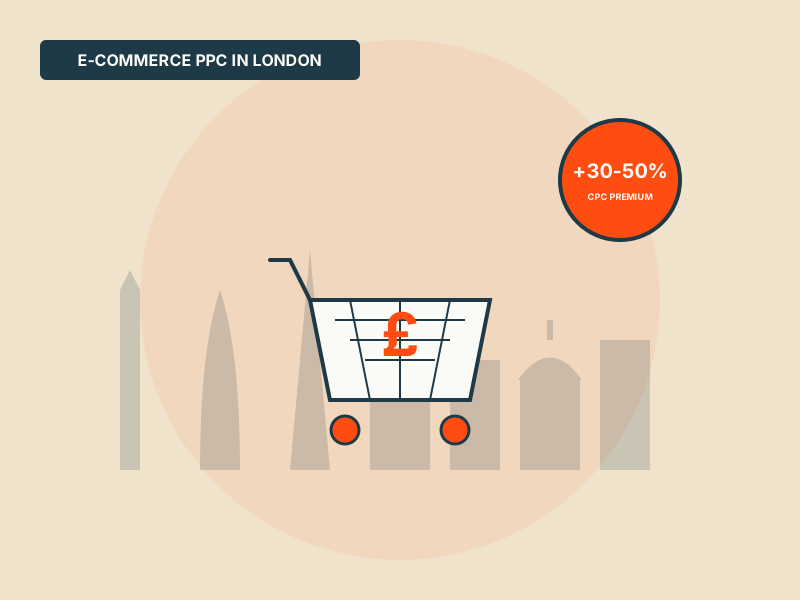
London-based e-commerce brands run PPC against higher-CPC, more-competitive auctions than peers in Manchester or Birmingham. The structural choices that change at this level.
E-commerce PPC has its own playbook, and London adds a layer on top. Brands selling from the UK's most expensive paid-search market, for whatever reason: HQ location, fulfilment, brand identity tied to London, run different economics than peers in Manchester, Birmingham or Leeds.
If you're a London-based e-commerce business, or you're selling specifically to a London market segment, here's what's different about the PPC playbook compared to general UK e-commerce. This is the practical version, not the obvious "London is competitive" content you'll find elsewhere.
What's different about London e-commerce PPC
1. Higher CPCs across the board, but unevenly.
London average CPCs across e-commerce categories run 30-50% higher than UK regional equivalents. But the spread is not uniform:
- Fashion and apparel: ~30% premium over regional UK
- Home and garden: ~20-25% premium (less London-skewed customer base)
- Food and gift: ~40% premium (London-heavy delivery zones, hyper-competitive)
- Specialist gift / luxury: ~50%+ premium (heavy ad spend from competing London-positioned brands)
- Electronics and appliances: ~10-15% premium (mostly nationwide market, less London skew)
The implication: a London e-commerce brand running national campaigns is mostly paying London-level CPCs even when serving non-London customers, because the auction is dominated by London bidders. Worth checking by running geographic-segment reports, if your London CPC is meaningfully higher than your Manchester CPC for the same product, you may be over-spending on the London segment.
2. Performance Max behaves differently.
Performance Max in London e-commerce auctions is more aggressive, Google's algorithm sees high willingness-to-pay across the auction and bids accordingly. Pmax campaigns that work well at conservative ROAS targets in regional UK markets can run away with budget in London, because Google bids harder when it sees competitor activity.
The fix: tighter ROAS targets on London-targeted Pmax campaigns. If your standard target is 3.5x ROAS, London-targeted Pmax should probably be 4.0-4.5x. The algorithm needs to be told the auction's pricing makes lower targets uneconomic, or it'll spend through.
3. Brand defence is more expensive, and more necessary.
Competitor brand bidding is more aggressive in London e-commerce auctions. Generic brand-term defence (bidding on your own brand to defend the SERP) often costs 40-60% more in London than in regional markets, partly because trade-mark-violating bidders ignore Google's policies and partly because legitimate competitors test it more aggressively.
You can't skip brand defence in London e-commerce, the cost of an unprotected brand SERP is higher than the cost of defence. But the defence cost should be considered when budgeting, and brand defence specifically should be run as a separate campaign with its own budget rather than being lost inside a broader brand campaign.
4. Shopping feed quality matters more.
Because base CPCs are higher, the cost-of-mistake on Shopping campaigns is higher too. A poorly-segmented feed in regional UK might over-spend by £200-500/month; in London e-commerce the same feed quality drift can over-spend by £1,000-2,000/month.
What "feed quality" means in this context:
- Accurate `availability` (out-of-stock products getting clicks is pure waste)
- Strong `gtin`/`brand` data (Google ranks feed listings by completeness)
- Custom labels for ROAS-tier segmentation (high-margin products bid differently than low-margin)
- Image quality (Google now penalises low-resolution or generic images in feed listings)
A weekly feed audit is the regional UK best practice. London e-commerce should run a Daily feed audit if spend is over £15k/month, the cost of feed drift compounds faster.
5. Multi-channel paid programmes work harder.
Most London e-commerce brands at scale run Google + Microsoft + Meta + sometimes TikTok. The point isn't that London markets need more channels (regional brands run multi-channel too); it's that channel-arbitrage opportunities are bigger in London because the Google auction is the most overpriced.
Specifically:
- Microsoft Ads + Bing Shopping is consistently 30-50% cheaper than equivalent Google Shopping, with smaller but real volume. Worth 10-20% of Shopping budget if your category overlaps with Bing's user demographic.
- Pinterest Shopping can be efficient for visual product categories at London prices, particularly fashion and home.
- Amazon Ads for products that have Amazon listings, often runs at lower CPCs than Google Shopping for the same product.
A London e-commerce brand on Google-only is leaving channel-arbitrage savings on the table that wouldn't be worth chasing at regional UK prices but are at London prices.
The structural choices that change
Beyond the operational differences, three structural choices change for London e-commerce PPC:
Account architecture:
- Geographic-first segmentation (London / SE England / rest of UK) rather than product-first segmentation
- Separate brand-defence campaigns from main campaigns (not buried inside)
- Tighter Pmax asset-group structure (one per intent, not one catch-all)
Bidding:
- Tighter ROAS targets on London-segment campaigns
- More conservative new-campaign learning periods (don't broaden too fast)
- Currency-aware Conversion Value Rules if you sell internationally as well as UK
Reporting:
- London-segment performance broken out from total UK
- Channel-arbitrage tracking (Microsoft vs Google CPC for same query, monthly)
- Brand-defence cost-effectiveness tracked separately from main campaign performance
When you should hire a London-experienced PPC team
You should specifically hire a team with London e-commerce experience when:
- 50%+ of your customers are London-based, OR
- You're a London-positioned brand even with non-London customers (the auction sees you as London-bidder), OR
- You compete directly with named London e-commerce brands in your category
Below those triggers, regional UK PPC management is fine. The London-specific playbook becomes worth the premium when London-auction economics dominate your account.
For more London-specific operating context see Google Ads management in London and Hiring a Google Ads consultant in London.
Where we sit
WMI is a London-based PPC consultancy. Most accounts we run are UK-based, with a meaningful share competing in London auctions. We treat London-segment performance as its own analytical unit, run channel-arbitrage Microsoft testing as standard, and structure accounts geographically when London is a major share of business.
For an audit specific to your London e-commerce account, book a free audit. We'll run the geographic-segment breakdown as part of the standard audit and flag where London-auction economics are costing you more than they should.
Get a free PPC audit from the team that wrote this.
We'll review your Google Ads or Microsoft Ads account and show you three specific things we'd change in the first 30 days.